Antarctic Research
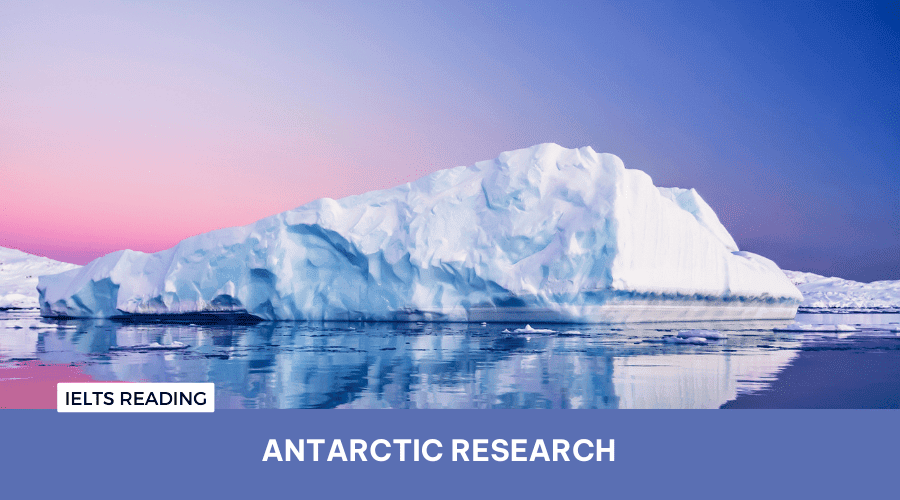
A A little over a century ago, men of the ilk of Scott, Shackleton and Mawson battled against Antarctica’s blizzards, cold and deprivation. In the name of Empire and in an age of heroic deeds they created an image of Antarctica that was to last well into the 20th century – an image of remoteness, hardship, bleakness and isolation that was the province of only the most courageous of men. The image was one of a place removed from everyday reality, of a place with no apparent value to anyone.
B As we enter the 21st century, our perception of Antarctica has changed. Although physically Antarctica is no closer and probably no warmer, and to spend time there still demands a dedication not seen in ordinary life, the continent and its surrounding ocean are increasingly seen to an integral part of Planet Earth, and a key component in the Earth System. Is this because the world seems a little smaller these days, shrunk by TV and tourism, or is it because Antarctica really does occupy a central spot-on Earth’s mantle? Scientific research during the past half-century has revealed – and continues to reveal – that Antarctica’s great mass and low temperature exert a major influence on climate and ocean circulation, factors which influence the lives of millions of people all over the globe.
C Antarctica was not always cold. The slow break-up of the super-continent Gondwana with the northward movements of Africa, South America, India and Australia eventually created enough space around Antarctica for the development of an Antarctic Circumpolar Current (ACC), that flowed from west to east under the influence of the prevailing westerly winds. Antarctica cooled, its vegetation perished, glaciation began and the continent took on its present-day appearance. Today the ice that overlies the bedrock is up to 4km thick, and surface temperatures as low as – 89.2deg C have been recorded. The icy blast that howls over the ice cap and out to sea – the so-called katabatic wind – can reach 300 km/hr, creating fearsome wind-chill effects.
D Out of this extreme environment come some powerful forces that reverberate around the world. The Earth’s rotation, coupled to the generation of cells of low pressure off the Antarctic coast, would allow Astronauts a view of Antarctica that is as beautiful as it is awesome. Spinning away to the northeast, the cells grow and deepen, whipping up the Southern Ocean into the mountainous seas so respected by mariners. Recent work is showing that the temperature of the ocean may be a better predictor of rainfall in Australia than is the pressure difference between Darwin and Tahiti – the Southern Oscillation Index. By receiving more accurate predictions, graziers in northern Queensland are able to avoid overstocking in years when rainfall will be poor. Not only does this limit their losses but it prevents serious pasture degradation that may take decades to repair. CSIRO is developing this as a prototype forecasting system, but we can confidently predict that as we know more about the Antarctic and the Southern Ocean we will be able to enhance and extend our predictive ability.
E The ocean’s surface temperature results from the interplay between deep-water temperature, air temperature and ice. Each winter between 4 and 19 million square km of sea ice form, locking up huge quantities of heat close to the continent. Only now can we start to unravel the influence of sea ice on the weather that is experienced in southern Australia. But in another way, the extent of sea ice extends its influence far beyond Antarctica. Antarctic krill – the small shrimp-like crustaceans that are the staple diet for baleen whales, penguins, some seals, flighted sea birds and many fish – breed well in years when sea ice is extensive and poorly when it is not. Many species of baleen whales and flighted sea birds migrate between the hemispheres and when the krill are less abundant they do not thrive.
F The circulatory system of the world’s oceans is like a huge conveyor belt, moving water and dissolved minerals and nutrients from one hemisphere to the other, and from the ocean’s abyssal depths to the surface. The ACC is the longest current in the world and has the largest flow. Through it, the deep flows of the Atlantic, Indian and Pacific Oceans are joined to form part of single global thermohaline circulation. During winter, the howling katabatics sometimes scour the ice off patches of the sea’s surface leaving large ice-locked lagoons, or ‘polynyas. Recent research has shown that as fresh sea ice forms, it is continuously stripped away by the wind and maybe blown up to 90km in a single day. Since only freshwater freezes into ice, the water that remains becomes increasingly salty and dense, sinking until it spills over the continental shelf. Coldwater carries more oxygen than warm water, so when it rises, well into the northern hemisphere, it reoxygenates and revitalises the ocean. The state of the northern oceans and their biological productivity owe much to what happens in the Antarctic.
The reading Passage has seven paragraphs A-F
Which paragraph contains the following information?
Write the correct letter A-F, in boxes 14-18 on your answer sheet.
14 The example of research on weather prediction on agriculture
15 Antarctic Sea ice brings life back to the world oceans’ vitality.
16 A food chain that influences the animals living pattern based on Antarctic fresh sea ice
17 The explanation of how atmosphere pressure above Antarctica can impose an effect on global climate change
18 Antarctica was once thought to be a forgotten and insignificant continent
Summary
Please match the natural phenomenon with correct determined factor Choose the correct answer from the box;
Write the correct letter A-F, in boxes 19-21 on your answer sheet.
A Antarctic Circumpolar Current (ACC)
B katabatic winds
C rainfall
D temperature
E glaciers
F pressure
19 Globally, mass Antarctica’s size and....................... influence climate change
20 contributory to western wind
21 Southern Oscillation Index based on air pressure can predict........................ in Australia
Choose the correct letter A, B, C or D.
Write your answer in box 22-26 on your answer sheet.
22 In paragraph B, the author wants to tell which of the following truth about the Antarctic?
A To show Antarctica has been a central topic of global warming in Mass media
B To illustrate its huge sea ice brings food to million lives to places in the world
C To show it is the heart and its significance to the global climate and current
D To illustrate it locates in the central spot-on Earth geographically
23 Why do Australian farmers keep an eye on the Antarctic Ocean temperature?
A Help farmers reduce their economic or ecological losses
B Retrieve grassland decreased in the overgrazing process
C Prevent animal from dying
D A cell provides fertilizer for the grassland
24 What is the final effect of katabatic winds?
A Increase the moving speed of ocean current
B Increase salt level near the ocean surface
C Bring fresh ice into southern oceans
D Pile up the mountainous ice cap respected by mariners
25 The break of the continental shelf is due to the
A Salt and density increase
B Salt and density decrease
C global warming resulting in a rising temperature
D fresh ice melting into ocean water
26 The decrease in the number of Whales and seabirds is due to
A killers whales are more active around
B Sea birds are affected by high sea level salty
C less sea ice reduces the productivity of food source
D seals fail to reproduce babies
14. D (Đoạn D; Cho ví dụ về dự đoán nhiệt độ tại Queensland)
15. F (Đoạn F; Lượng băng mà Đại tây dương mang lại giúp đem lại sự sống cho trái đất)
16. E (Đoạn E; Bàn về chuỗi thức ăn của một số loài động vật khác nhau)
17. C (Đoạn C; Giải thích vì sao áp suất ở Đại tây dương có thể gây ra biến đổi khí hậu)
18. A (Đoạn A; Đại tây dương từng bị trôi vào quên lãng)
19. D (Đoạn B, “that Antarctica’s great mass and low temperature exert a major influence on climate and ocean circulation, factors which influence the lives of millions of people all over the globe.”
20. A (Đoạn C, “ Antarctic Circumpolar Current (ACC), that flowed from west to east under the influence of the prevailing westerly winds.”)
21. C (Đoạn D, “Recent work is showing that the temperature of the ocean may be a better predictor of rainfall in Australia than is the pressure difference between Darwin and Tahiti – the Southern Oscillation Index.”
22. C (Đoạn B, “…that Antarctica’s great mass and low temperature exert a major influence on climate and ocean circulation, factors which influence the lives of millions of people all over the globe.”)
23. A (Đoạn D, “By receiving more accurate predictions, graziers in northern Queensland are able to avoid overstocking in years when rainfall will be poor. Not only does this limit their losses but it prevents serious pasture degradation that may take decades to repair.”)
24. C (Đoạn C, “The icy blast that howls over the ice cap and out to sea – the so-called katabatic wind – can reach 300 km/hr, creating fearsome wind-chill effects.”)
25. C (Đoạn F, “Since only freshwater freezes into ice, the water that remains becomes increasingly salty and dense, sinking until it spills over the continental shelf. Coldwater carries more oxygen than warm water, so when it rises, well into the northern hemisphere, it reoxygenates and revitalises the ocean.”)
26. C (Đoạn E, “ Antarctic krill – the small shrimp-like crustaceans that are the staple diet for baleen whales, penguins, some seals, flighted sea birds and many fish – breed well in years when sea ice is extensive and poorly when it is not.”)
Nghiên Cứu Nam Cực
A Hơn một thế kỷ trước, những người như Scott, Shackleton và Mawson đã chiến đấu chống lại những cơn bão tuyết, cái lạnh và sự thiếu thốn ở Nam Cực. Nhân danh Đế chế và trong thời đại của những hành động anh hùng, họ đã tạo nên một hình ảnh về Nam Cực kéo dài mãi đến thế kỷ 20 - một hình ảnh về sự xa xôi, gian khổ, hoang vắng và cô lập mà chỉ những người can đảm nhất mới có thể chịu đựng. Hình ảnh đó là về một nơi cách xa thực tế hàng ngày, một nơi dường như không có giá trị đối với bất kỳ ai.
B Khi chúng ta bước vào thế kỷ 21, nhận thức của chúng ta về Nam Cực đã thay đổi. Mặc dù về mặt vật lý, Nam Cực không gần hơn và có lẽ cũng không ấm hơn, và việc dành thời gian ở đó vẫn đòi hỏi một sự cống hiến không thể thấy trong cuộc sống hàng ngày, lục địa này và đại dương xung quanh nó ngày càng được xem là một phần không thể thiếu của Hành tinh Trái Đất, và là một thành phần chính trong Hệ thống Trái Đất. Có phải vì thế giới ngày nay có vẻ nhỏ hơn, thu hẹp bởi truyền hình và du lịch, hay vì Nam Cực thực sự chiếm một vị trí trung tâm trên lớp phủ của Trái Đất? Nghiên cứu khoa học trong nửa thế kỷ qua đã và đang tiết lộ rằng khối lượng lớn và nhiệt độ thấp của Nam Cực có ảnh hưởng lớn đến khí hậu và tuần hoàn đại dương, những yếu tố ảnh hưởng đến cuộc sống của hàng triệu người trên khắp thế giới.
C Không phải lúc nào Nam Cực cũng lạnh lẽo. Sự tách ra chậm chạp của siêu lục địa Gondwana cùng với sự di chuyển về phía bắc của Châu Phi, Nam Mỹ, Ấn Độ và Úc cuối cùng đã tạo đủ không gian xung quanh Nam Cực để hình thành một Dòng chảy Nam Cực (ACC), chảy từ tây sang đông dưới tác động của những cơn gió tây thổi mạnh. Nam Cực trở nên lạnh hơn, thảm thực vật bị tiêu diệt, quá trình đóng băng bắt đầu và lục địa này có được diện mạo như ngày nay. Hiện nay, lớp băng phủ lên nền đá có thể dày tới 4km, và nhiệt độ bề mặt thấp nhất là – 89,2 độ C đã được ghi nhận. Cơn gió băng giá thổi qua chỏm băng và ra biển - được gọi là gió katabatic - có thể đạt tới 300 km/giờ, tạo ra những hiệu ứng lạnh khủng khiếp.
D. Từ môi trường khắc nghiệt này xuất hiện những lực mạnh mẽ ảnh hưởng đến toàn thế giới. Sự tự quay của Trái đất, kết hợp với sự hình thành các vùng áp thấp ngoài khơi bờ biển Nam Cực, sẽ cho phép các phi hành gia nhìn thấy Nam Cực tuyệt đẹp và hùng vĩ. Xoáy về phía đông bắc, các vùng áp thấp phát triển và sâu hơn, khuấy động vùng biển Nam thành những con sóng lớn được các thủy thủ nể trọng. Các nghiên cứu gần đây cho thấy nhiệt độ của đại dương có thể dự báo lượng mưa ở Úc tốt hơn so với sự chênh lệch áp suất giữa Darwin và Tahiti - Chỉ số dao động Nam (SOI). Bằng cách nhận được dự báo chính xác hơn, những người chăn gia súc ở phía bắc Queensland có thể tránh chăn thả quá nhiều gia súc trong những năm có lượng mưa thấp. Điều này không chỉ hạn chế tổn thất của họ mà còn ngăn chặn sự suy thoái nghiêm trọng của đồng cỏ, có thể mất hàng thập kỷ để khắc phục. CSIRO đang phát triển hệ thống dự báo nguyên mẫu này, nhưng chúng ta có thể tự tin dự đoán rằng khi chúng ta biết thêm về Nam Cực và vùng biển Nam, chúng ta sẽ có thể cải thiện và mở rộng khả năng dự báo của mình.
E. Nhiệt độ bề mặt đại dương là kết quả của sự tương tác giữa nhiệt độ nước sâu, nhiệt độ không khí và băng. Mỗi mùa đông, có từ 4 đến 19 triệu km vuông băng biển hình thành, giữ lại một lượng nhiệt khổng lồ gần lục địa. Chỉ đến bây giờ, chúng ta mới bắt đầu khám phá ra ảnh hưởng của băng biển đối với thời tiết ở miền nam Australia. Nhưng theo một cách khác, phạm vi của băng biển mở rộng ảnh hưởng của nó vượt xa Nam Cực. Tôm hùm Nam Cực - những loài giáp xác nhỏ giống tôm, là nguồn thức ăn chính cho cá voi balen, chim cánh cụt, một số loài hải cẩu, chim biển bay và nhiều loài cá - sinh sản tốt trong những năm băng biển rộng lớn và kém trong những năm băng ít. Nhiều loài cá voi balen và chim biển bay di cư giữa các bán cầu và khi tôm hùm ít phong phú hơn, chúng không phát triển mạnh.
F. Hệ thống tuần hoàn của các đại dương trên thế giới giống như một băng chuyền khổng lồ, di chuyển nước và các khoáng chất hòa tan và chất dinh dưỡng từ bán cầu này sang bán cầu khác, và từ độ sâu thẳm của đại dương lên bề mặt. Dòng chảy Nam Cực (ACC) là dòng chảy dài nhất thế giới và có lưu lượng lớn nhất. Thông qua nó, các dòng chảy sâu của Đại Tây Dương, Ấn Độ Dương và Thái Bình Dương được nối lại để tạo thành một phần của hệ thống tuần hoàn nhiệt động học. Vào mùa đông, gió Katabatic thét gào đôi khi quét sạch băng trên những mảng bề mặt biển, tạo ra các đầm phá lớn bị đóng băng, hoặc 'polynya'. Các nghiên cứu gần đây cho thấy khi băng biển mới hình thành, nó liên tục bị gió cuốn đi và có thể bị thổi bay tới 90km trong một ngày. Vì chỉ có nước ngọt đóng băng thành băng, nên nước còn lại ngày càng mặn và đặc hơn, chìm xuống cho đến khi tràn qua thềm lục địa. Nước lạnh chứa nhiều oxy hơn nước ấm, vì vậy khi nó bốc lên, đi sâu vào vùng bắc bán cầu, nó sẽ tái tạo oxy và hồi sinh đại dương. Tình trạng của các đại dương phía bắc và năng suất sinh học của chúng phụ thuộc nhiều vào những gì xảy ra ở Nam Cực.