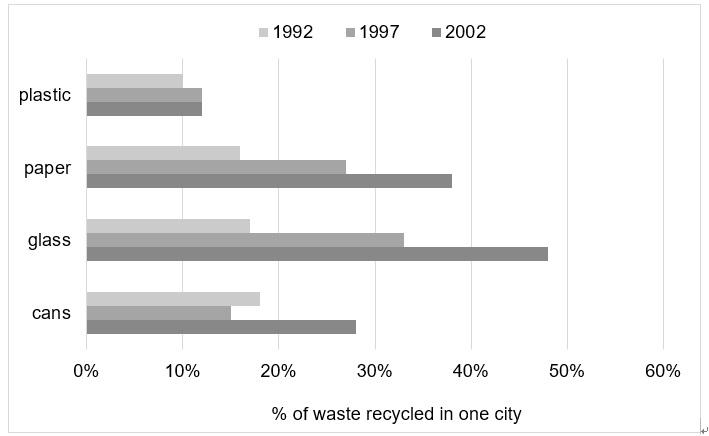
The chart below shows the percentage of different types of household waste that were recycled in one city between 1992 and 2002.
Summarize the information by selecting and reporting the main features, and make comparisons where relevant.
Write at least 150 words.
The bar chart illustrates the proportions of recycled domestic waste in the categories of plastic, cans, paper, and glass over a ten-year period, from 1992 to 2002.
Overall, there was an upward trend in the recycling rates for all four waste types, with the most notable change observed in the recycling of glass.
In the initial year, cans accounted for the highest proportion of recycled waste compared to the other three categories, constituting nearly 20% of the total. However, after a slight decline in the following five years, the recycling rate of cans experienced a significant surge, reaching close to 30% by the end of the period. By contrast, plastic had the lowest recycling rate in the starting year, merely 10%, and underwent a marginal increase of approximately 3% before stabilizing at this level in subsequent years.
It is worth noting that the other two waste categories experienced more substantial changes during the same period. Initially, only about 16% of glass waste was recycled and utilized. However, within the following five years, this figure doubled, and the recycling rate continued to grow steadily, eventually representing nearly half of the recycled waste in 2002. Similarly, the recycling rate of paper witnessed a consistent upward trajectory, rising from approximately 15% in 1994 to a considerable 38% in 2002.
(216 words)
Dưới đây là một số từ vựng hữu ích được sử dụng trong bài viết trên: