Trong bài viết này, chúng ta sẽ cùng tìm hiểu các cách diễn tả số lượng trong tiếng Anh và luyện tập để nắm chắc kiến thức này nhé.
1. SOME:
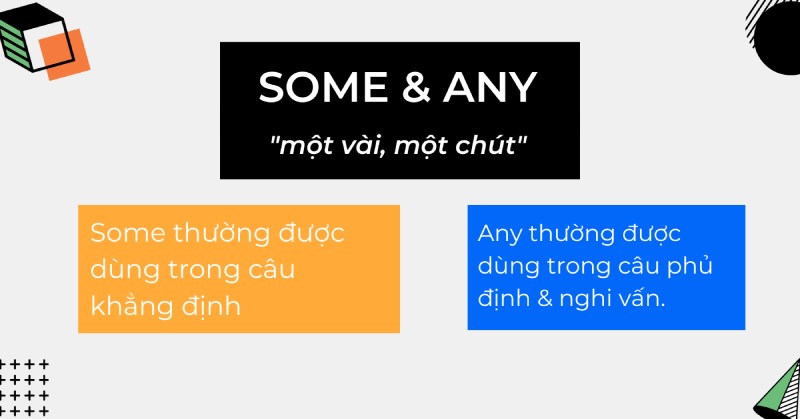
Some được đặt trước danh từ đếm được số nhiều (plural countable noun) hoặc danh từ không đếm được (uncountable noun) trong câu xác định.
Ex:
Đôi khi some được dùng trong câu hỏi (mời ai dùng thêm gì hoặc một đề nghị lịch sự)
Ex:
2. ANY:
Any thường được đặt trước danh từ đếm được hoặc danh từ không đếm được trong câu phủ định hoặc nghi vấn.
Ex:
* Lưu ý:
Các đại từ phiếm chỉ (something, anything, someone, anyone, somebody,...) cũng theo cách dùng trên.
Ex:
1. MOST:
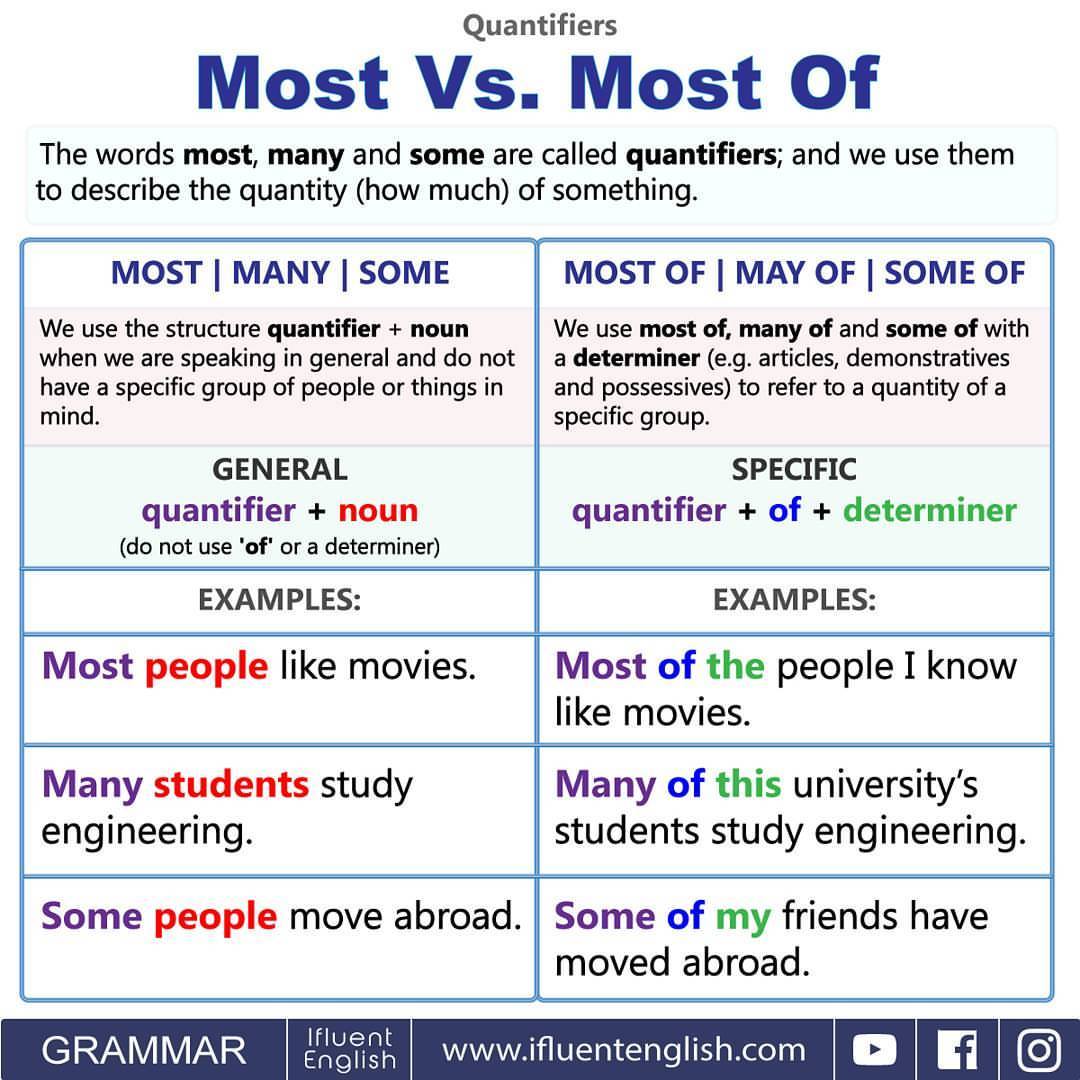
Most dùng trước danh từ đếm được số nhiều hoặc danh từ không đếm được. Most là từ hạn định trong cấu trúc:
MOST + NOUN
MOST + ADJECTIVE + NOUN
Ex:
2. MOST OF:
Most of dùng trước cụm danh từ số ít hoặc số nhiều.
MOST OF + DETERMINER/ PRONOUN + NOUN
Ex:
* Lưu ý: Các cụm danh từ đứng sau most of thường xác định (phải có the, this, these, those,... hoặc các tính từ sở hữu my, his, her...)
Ex:
With countable nouns (Với các danh từ đếm được) many a large number of a great number of plenty of a lot of lots of
| With uncountable nouns (Với các danh từ không đếm được) much (thường dùng trong câu phủ định hoặc nghi vấn) a great deal of (thường dùng trong câu xác định) a large amount of plenty of a lot of lots of |
1. Much/ many
Much: Được sử dụng để chỉ một lượng lớn hoặc mức độ, thường đi với các danh từ không đếm được. Ví dụ: "There isn't much time left."
Many: Được sử dụng để chỉ một số lượng lớn, thường đi với các danh từ đếm được. Ví dụ: "There are many books on the shelf."
2. A large number of, Plenty of, A great number of, A lot of, Lots of
Các cụm từ này đều có nghĩa là "nhiều" và thường được sử dụng như nhau để chỉ số lượng lớn hay đủ. Chúng thường đi với cả danh từ đếm được lẫn không đếm được. Ví dụ: "There are a lot of people at the party."
Ex:
* Lưu ý: Khi trong câu xác định có các từ very, too, so, as thì phải dùng much hoặc many.
Ex:
1. Few, a few
Few/ A Few: dùng trước các danh từ đếm được số nhiều (plural countable nouns).
Few: rất ít, hầu như không có (ít hơn những gì bạn muốn hoặc mong đợi)
Ex:
A few: một vài (gần nghĩa với some)
Ex:
2. Little / a little
Little/ A Little: dùng trước các danh từ không đếm được (uncountable nouns).
Little:rất ít (ít hơn những gì bạn muốn hoặc mong đợi)
Ex:
A little: một ít, một chút (gần nghĩa với some)
Ex:
I. Choose the correct words in the following sentences.
1. He doesn’t have (many/ much) money.
2. I would like (a few/ a little) salt on my vegetables.
3. She bought (many/ much) cards last night.
4. There are (less/ fewer) boys in this class than in the next class.
5. There is (too many/ too much) information to learn.
6. Would you like (less/ fewer) coffee than this?
7. This jacket costs (too much/ too many).
8. I don’t want (some/ any) eggs but I want (any/ some) cheese.
9. Is there (some/ any) water in the glass?
10. (How much/ How many) pounds of butter does she want?
11. (How much/ How many) butter does she want?
12. Is there (some/ any) tea in the cup?
13. Peter doesn’t want (something/ anything) to do.
14. I can speak (a few/ a little) English.
15. They don’t need (some/ any) coffee.
16. I can’t buy that house because I have (few/ little) money.
17. They have given (a large number of/ a great deal of) time on training.
18. The teacher found (a large number of/ a great deal of) mistakes in his writing.
19. I can drink (a few/ a little) wine.
20. Give me (a few/ a little) examples.
II. Fill in each of the blanks with MOST or MOST OF.
1. adolescents can hardly find a suitable job.
2. There are 50 students in my class. them can hardly find a suitable job.
3. the time he spent on learning was fairly reasonable.
4. men and women apply for that job, but them aren’t often qualified.
5. She gave her energy to science.
III. Fill in each of the blanks with A GREAT DEAL OF/ A LARGE NUMBER OF/ MUCH (OF)/ MANY (OF)
1. learner’s attention should be paid to the use of the English tenses.
2. today’s scientific work is involved in the use of computers.
3. Are your photos in colour or in black and white?
4. She put too sugar in the coffee. It became so sweet that I couldn’t drink it.
5. Thank you very for your valuable help.
6. He wrote play, but his plays couldn’t be staged.
7. Do you have enough exercises to do now? Oh, too .
8. How time do you spend on learning English every day?
9. How these children are qualified for the job?
10. She doesn’t know about what to do in response to his kind-heartedness.
11. people know him as a devoted doctor.
12. He loved so fun that his lessons were never well-prepared.
13. She is very rich. She has money in the bank.
14. goods were sent to the exhibition.
15. They have found mistakes in the accounts.
16. Mrs Green has spent time in Ho Chi Minh City.
17. I have got homework to do today.
18. trees are cut to make paper every year.
19. Please buy soap.
20. How money have you got?
IV. Insert SOME, ANY, SOMEONE, ANYONE, SOMEWHERE, AWYWHERE where required.
1. Will you have tea?
2. You’re expecting to call, aren’t you?
3. Haven’t I given you money this week? I must have forgotten you.
4. If you haven’t money, you can get from the bank.
5. Are you expecting else? If not, we’ll go for drink.
6. Please buy butter for mother.
7. I have new dresses.
8. She doesn’t want ice-cream.
9. I have bought furniture.
10. Why don’t you ask the bank for money?
V. Fill in each blank with LITTLE/ FEW or A LITTLE/ A FEW (OF).
1. She gave ________ thought to her future.
2. Would you like ________ coffee? Yes, please. But put sugar in it.
3. ________ your friends will have to repeat the course owing to their weakness.
4. Can you speak French? Just ________.
5. If you have ________ knowledge of English grammar, you can’t make correct sentences.
6. I had ________ time to look after my children.
7. She just spends ________ her money on clothes.
8. ________ these children will go to work at a garage.
9. The windows are so small that the room gets ________ air.
10. He is not popular. He has ________ friends.
VI. Fill in each blank with a proper expression of quantity.
1. I feel lonely and don’t enjoy my life here because I have friends in this city.
2. tourists have not visited this part of the town yet.
3. the people at the party were very friendly.
4. Are those people English? them.
5. schools open in September.
6. Let’s go and have a drink. We’ve got time before the train leaves.
7. I need some money. Have you got any? Yes, but not .
8. The race gave everyone pleasure.
9. Hurry or we’ll be late. We have very time.
10. I have done exercises of grammar in this book.
11. the people in Canada speak English.
12. The Smiths spent money on their last trip.
13. I do not know about biology. I have knowledge about genetics.
14. The librarian says that you may borrow as books as you want to.
15. The boys are making too noise.
16. We spend our time on English grammar.
17. I’m very poor. I have money. But my brother is richer than I. He has money in the bank.
18. English learners have real chance to use it every day.
19. There is sugar in the jar.
20. Did children know anything about their future job/ No, just .
21. You talk too and you often do too tricks in class.
22. people are afraid of snakes.
23. Vietnamese people make their living by farming.
24. How languages can you speak? And how time do you spend on learning English?
25. How do you know about biology and genetics?
26. machinery was sent to the exhibition.
27. furniture in her room is new.
28. us feel the same about the war.
29. reporters were at the meeting yesterday.
30. meat is expensive.
I.
1. much 2. a little 3. many 4. fewer
5. too much 6. less 7. too much 8. any/ some
9. any 10. how many 11. how much 12. any
13. anything 14. a little 15. any 16. little
17. a great deal of 18. a large number of 19. a little 20. a few
II.
1. Most
2. Most of
3. Most of
4. Most – most of
5. Most of
III.
1. A great deal of 2. A great deal of
3. many of 4. Much
5. much 6. Many of
7. many 8. Much
9. many of 10. Much
11. a large number of/ many 12. Much – a large number of/ many of
13. a great deal of 14. A large number of
15. many/ a large number of 16. A great deal of
17. a great deal of 18. A large number of
19. a great deal of 20. Much
IV.
1. some 2. some one 3. any
4. any – some 5. anyone – somewhere
6. some 7. some 8. any
9. little 10. few
V.
1. little 2. a little – little 3. a few of 4. a little 5. little
6. little 7. little of 8. a few of 9. little 10. few
VI.
1. few 2. Some/ many/ A large number of
3. Most of 4. Most of
5. Most 6. a little
7. much 8. a great deal of
9. little 10. most/ a large number of/ many
11. most of 12. Much
13. much- little 14. Many
15. much 16. most of
17. little - a great deal of 18. Few
19. little/ a little 20. many – a few
21. much - many 22. Most/ Many/ A large number of
23. Most of 24. many – much
25. much 26. A great deal of
27. Most 28. Most of
29. Some/ Many/ A large number of 30. Most