Human Interference and Finches
Today, the quest continues. On Daphne Major - -one of the most desolate of the Galápagos Islands, an uninhabited volcanic cone where cacti and shrubs seldom grow higher than a researcher's knee Peter and Rosemary Grant have spent more than three decades watching Darwin's finches respond to the challenges of storms, drought and competition for food. Biologists at Princeton University, the Grants know and recognize many of the individual birds on the island and can trace the birds' lineages back through time. They have witnessed Darwin's principle in action again and again, over many generations of finches.
The Grants' most dramatic insights have come from watching the evolving bill of the medium ground finch. The plumage of this sparrow-sized bird ranges from dull brown to jet black. At first glance, it may not seem particularly striking, but among scientists who study evolutionary biology, the medium ground finch is a superstar. Its bill is a middling example in the array of shapes and sizes found among Galapagos finches: heftier than that of the small ground finch, which specializes in eating small, soft seeds, but petite compared to that of the large ground finch, an expert at cracking and devouring big, hard seeds.
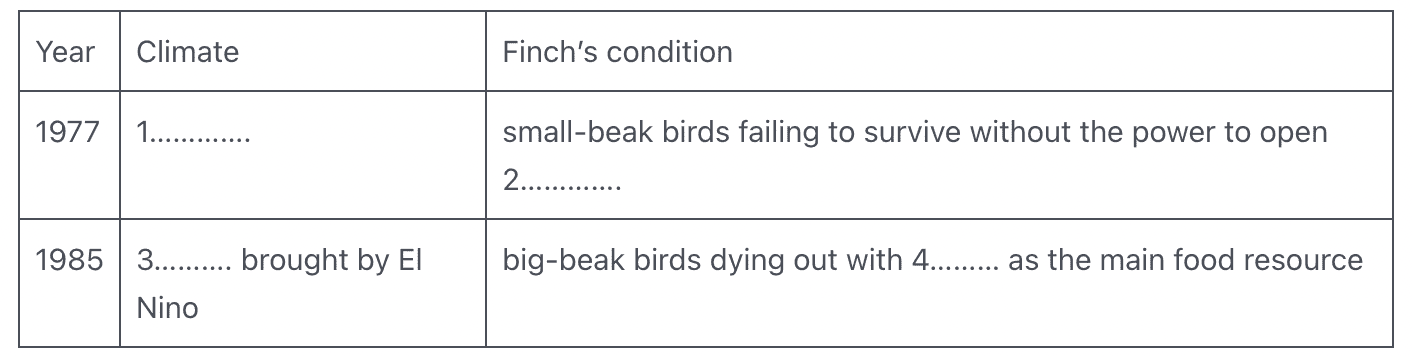
When the Grants began their study in the 1970s, only two species of finch lived on Daphne Major, the medium ground finch and the cactus finch. The island is so small that the researchers were able to count and catalogue every bird. When a severe drought hit in 1977, the birds soon devoured the last of the small, easily eaten seeds. Smaller members of the medium ground finch population, lacking the bill strength to crack large seeds, died out.
Bill and body size are inherited traits, and the next generation had a high proportion of big- billed Individuals. The Grants had documented natural selection at work the same process that over many millennia, directed the evolution of the Galápagos' 14 unique finch species, all descended from a common ancestor that readied the islands a few million years ago.
Eight years later, heavy rains brought by an El Nino transformed the normally meager vegetation on Daphne Major. Vines and other plants that in most years struggle for survival suddenly flourished, choking out the plants that provide large seeds to the finches. Small seeds came to dominate the food supply, and big birds with big bills died out at a higher rate than smaller ones. 'Natural selection is observable/ Rosemary Grant says. 'It happens when the environment changes. When local conditions reverse themselves, so does the direction of adaptation.'
Recently, die Grants witnessed another form of natural selection acting on the medium ground finch: competition from bigger, stronger cousins. In 1982, a third finch, the large ground finch, came to live on Daphne Major. The stout bills of these birds resemble the business end of a crescent wrench. Their arrival was the first such colonization recorded on the Galapagos in nearly a century of scientific observation. 'We realized,' Peter Grant says, 'we had a very unusual and potentially important event to follow. For 20 years, the large ground finch coexisted with the medium ground finch, which shared five supply of large seeds with its bigger-billed relative. Then, in 2002 and 2003, another drought struck. None of the birds nested that year, and many died out. Medium ground finches with large bills,crowded out of feeding areas by the more powerful large ground finches, were hit particularly hard.
When wetter weather returned in 2004, and the finches nested again, the new generation of the medium ground finch was dominated by smaller birds with smaller bills, able to survive on smaller seeds. This situation, says Peter Grant, marked the first time that biologists have been able to follow the complete process of an evolutionary change due to competition between, species and the strongest response to natural selection that he had seen in 33 years of tracking Galapagos finches.
On the inhabited island of Santa Cruz, just south of Daphne Major, Andrew Hendry of McGill University and Jeffrey Podos of the University of Massachusetts at Amherst have discovered a new, man-made twist in finch evolution. Their study focused on birds living near the Academy Bay research station, on the fringe of the town of Puerto Ayora. The human population of the area has been growing fast-from 900 people in 1974 to 9,582 In 2001. Today Puerto Ayorn is full of hotels and maitai bars,' Hendry says. 'People have taken this extremely arid place and tried to turn it Into a Caribbean resort.
Academy Bay records dating back to the early 1960s show that medium ground finches captured there had either small or large bills. Very few of the birds had mid-size bills. The finches appeared to be in the early stages of a new adaptive radiation: If the trend continued, the medium ground finch on Santa Cruz could split into two distinct subspecies, specializing in different types of seeds. But in the late 1960s and early 70s, medium ground finches with medium-sized bills began to thrive at Academy Bay along with small and largebilled birds. The booming human population had introduced new food sources, including exotic plants and bird feeding stations stocked with rice. Billsize, once critical to the finches' survival, no longer made any difference. 'Now an intermediate bill can do fine/ Hendry says.
At a control site distant from Puerto Ayora, and relatively untouched by humane, the medium ground finch population remains split between large- and small-billed birds. On undisturbed parts of Santa Cruz, there is no ecological niche for a middling medium ground finch, and the birds continue to diversify. In town, though there are still many finches, once-distinct populations are merging.
The finches of Santa Cruz demonstrate a subtle process in which human meddling can stop evolution In Its tracks, outing the formation of new species. In a time when global biodiversity continues Its downhill slide, Darwin's finches have yet another unexpected lesson to teach. 'If we hope to regain some of the diversity that's already been lost/ Hendry says, 'we need to protect not just existing creatures, but also the processes that drive the origin of new species!
Complete the table below.
Complete the following summary of the paragraphs of Reading Passage 1, using NO MORE THAN TWO WORDS from the Reading Passage for each answer. Write your answers in boxes 5-8 on your answer sheet
On the remote island of Santa Cruz, Andrew Hendry and Jeffrey Podos conducted a study on reversal in 5..............due to human activity. In the early 1960s medium ground finches were found to have a larger or smaller beak. But in the late 1960b and early 70s, finches with 6..............flourished. The study speculates that it is due to the growing 7................who brought in alien plants along with 8......... into the area.
Do die following statements agree with the information given in Reading Passage 1?
In boxes 9-13 on your answer sheet, write
TRUE if the statement is true
FALSE if the statement is false
NOT GIVEN if the information is not given in the passage
9. Grants' discovery has questioned Darwin's theory.
10. The cactus finches are less affected by food than the medium ground finch.
11. In 2002 and 2003, all the birds were affected by the drought.
12. The discovery of Andrew Hendry and Jeffrey Podos was the same as that of the previous studies.
13. It is shown that the revolution in finches on Santa Cruz is likely a response to human intervention.
1. (Severe) drought
2. Large seeds
3. Heavy rains
4. Small seeds
5. Finch evolution
6. Medium-sized bills
7. Human population
8. Rice
9. False
10. Not given
11. True
12. False.
13. True
Sự can thiệp của con người và chim sẻ
Ngày nay, cuộc tìm kiếm vẫn tiếp diễn. Ở Daphne Major - - một trong những quần đảo Galápagos hoang vắng nhất, một núi lửa hoang sơ không có dân cư, nơi cây xương rồng và cây bụi hiếm khi mọc cao hơn đầu gối của một nhà nghiên cứu, Peter và Rosemary Grant đã dành hơn ba thập kỷ theo dõi những con chim sẻ Darwin đối mặt với thách thức từ bão, hạn hán và sự cạnh tranh về thức ăn. Là nhà sinh học tại Đại học Princeton, hai vợ chồng Grant biết và nhận diện nhiều con chim riêng lẻ trên hòn đảo và có thể truy tìm nguồn gốc của chúng từ quá khứ. Họ đã chứng kiến nguyên tắc của Darwin diễn ra lần lượt, qua nhiều thế hệ của loài chim sẻ.
Những hiểu biết sâu sắc nhất của Grants đến từ việc theo dõi quá trình phát triển của loài chim sẻ mặt đất cỡ trung bình. Lông của loài chim nhỏ gọn này có màu từ màu nâu nhạt đến đen đậm. Thoạt nhìn, có vẻ như nó không đặc biệt nổi bật, nhưng đối với các nhà khoa học nghiên cứu sinh học tiến hóa, loài chim sẻ đất trung bình là một ngôi sao. Mỏ của nó là một ví dụ điển hình về hàng loạt hình dạng và kích cỡ được tìm thấy ở loài chim sẻ đất Galapagos: nặng hơn mỏ của loài chim sẻ đất nhỏ, chuyên ăn những hạt nhỏ, mềm, nhưng nhỏ nhắn so với mỏ của loài chim sẻ đất lớn, một chuyên gia trong việc mở và ăn những hạt to, cứng.
Khi Grant bắt đầu nghiên cứu của mình vào những năm 1970, chỉ có hai loài chim sẻ sống trên Daphne Major, chim sẻ trung bình và chim sẻ xương rồng. Hòn đảo này nhỏ bé đến mức các nhà nghiên cứu có thể đếm và lập danh mục từng loài chim. Khi một đợt hạn hán nghiêm trọng xảy ra vào năm 1977, lũ chim nhanh chóng nuốt chửng những hạt giống nhỏ, dễ ăn cuối cùng. Các thành viên nhỏ hơn của quần thể chim sẻ đất trung bình, thiếu sức mạnh mỏ để bẻ hạt lớn, đã chết.
Mỏ và kích thước cơ thể là những đặc điểm di truyền và thế hệ tiếp theo có tỷ lệ cá thể mỏ to cao. Grants đã ghi lại quá trình chọn lọc tự nhiên diễn ra giống như quá trình trải qua nhiều thiên niên kỷ, chỉ đạo sự tiến hóa của 14 loài chim sẻ độc nhất ở Galápagos, tất cả đều có nguồn gốc từ một tổ tiên chung đã đổ bộ lên các hòn đảo cách đây vài triệu năm.
Tám năm sau, những trận mưa lớn do El Nino mang lại đã biến đổi thảm thực vật vốn thường cằn cỗi trên Daphne Major. Cây nho và các loại cây khác vốn đấu tranh sinh tồn trong nhiều năm đột nhiên phát triển mạnh mẽ, bóp nghẹt những cây cung cấp hạt lớn cho chim sẻ. Những hạt giống nhỏ dần chiếm ưu thế trong nguồn cung cấp thực phẩm, và những con chim lớn có mỏ to bị chết với tỷ lệ cao hơn những con nhỏ hơn. 'Có thể quan sát được sự chọn lọc tự nhiên/ Rosemary Grant nói. 'Nó xảy ra khi môi trường thay đổi. Khi các điều kiện địa phương tự đảo ngược thì hướng thích ứng cũng thay đổi theo.'
Gần đây, Grant đã chứng kiến một hình thức khác của chọn lọc tự nhiên đang ảnh hưởng đến chim sẻ trung bình: cạnh tranh từ các người anh em lớn mạnh hơn. Năm 1982, một loài chim sẻ thứ 3, chim sẻ đất lớn, đã đến sống trên Daphne Major. Cái mỏ to của những con chim này giống như đầu lưỡi liềm. Sự xuất hiện của chúng lần đầu tiên được ghi nhận trong khoảng gần một thế kỷ quan sát khoa học tại Galapagos. "Chúng tôi nhận ra," Peter Grant nói, "chúng tôi đã có một sự kiện rất đặc biệt và tiềm năng quan trọng để theo dõi. Trong 20 năm, loài chim sẻ đất lớn cùng tồn tại với loài chim sẻ đất cỡ trung bình, chúng chia sẻ 5 nguồn cung cấp hạt giống lớn với họ hàng có mỏ lớn hơn của nó. Sau đó, vào năm 2002 và 2003, một đợt hạn hán khác lại xảy ra. Năm đó không có con chim nào làm tổ và nhiều con đã chết. Những con chim sẻ mặt đất cỡ trung bình có mỏ lớn, bị những con chim sẻ mặt đất lớn mạnh hơn chen chúc ra khỏi khu vực kiếm ăn, bị ảnh hưởng đặc biệt nặng nề.
Khi thời tiết ẩm ướt hơn trở lại vào năm 2004 và chim sẻ làm tổ trở lại, thế hệ mới của loài chim sẻ đất cỡ trung bình bị thống trị bởi những loài chim nhỏ hơn với mỏ nhỏ hơn, có thể sống sót nhờ những hạt giống nhỏ hơn. Peter Grant cho biết, tình huống này đánh dấu lần đầu tiên các nhà sinh vật học có thể theo dõi toàn bộ quá trình thay đổi tiến hóa do sự cạnh tranh giữa các loài và phản ứng mạnh mẽ nhất đối với chọn lọc tự nhiên mà ông đã thấy trong 33 năm theo dõi loài chim sẻ Galapagos.
Trên hòn đảo có người ở Santa Cruz, ngay phía nam Daphne Major, Andrew Hendry thuộc Đại học McGill và Jeffrey Podos thuộc Đại học Massachusetts ở Amherst đã phát hiện ra một bước ngoặt mới do con người tạo ra trong quá trình tiến hóa của chim sẻ. Nghiên cứu của họ tập trung vào các loài chim sống gần trạm nghiên cứu Vịnh Academy, ở rìa thị trấn Puerto Ayora. Dân số trong khu vực này đã tăng nhanh - từ 900 người năm 1974 lên 9.582 người vào năm 2001. "Ngày nay Puerto Ayorn có đầy đủ các khách sạn và quán bar maitai,” Hendry nói. 'Mọi người đã tận dụng nơi cực kỳ khô cằn này và cố gắng biến nó thành một khu nghỉ dưỡng ở Caribe.
Các bản ghi của Academy Bay từ những năm đầu 1960 cho thấy rằng loài chim sẻ trung bình được bắt ở đó có mỏ nhỏ hoặc mỏ lớn. Rất ít con chim có mỏ kích thước trung bình. Dường như chim sẻ đang ở giai đoạn đầu của một sự bùng nổ tiến hóa mới: Nếu xu hướng tiếp tục, chim sẻ trung bình trên Santa Cruz có thể chia thành hai phân loài riêng biệt, chuyên biệt ăn các loại hạt khác nhau. Nhưng vào cuối những năm 1960 và đầu những năm 70, loài chim sẻ đất cỡ trung bình với mỏ cỡ trung bình bắt đầu phát triển mạnh ở Vịnh Academy cùng với các loài chim mỏ nhỏ và lớn. Dân số bùng nổ đã mang đến những nguồn thực phẩm mới, bao gồm các loài thực vật ngoại lai và các trạm cung cấp thức ăn cho chim chứa đầy gạo. Kích thước mỏ, một yếu tố từng rất quan trọng cho sự sống còn của chim sẻ, nay không còn quan trọng nữa. "Bây giờ một con chim mỏ kích thước trung bình cũng có thể kiếm ăn tốt", Hendry nói.
Tại một địa điểm kiểm soát cách xa Puerto Ayora và tương đối không bị ảnh hưởng bởi hoạt động của con người, quần thể chim sẻ mặt đất cỡ trung bình vẫn bị chia rẽ giữa các loài chim mỏ lớn và chim mỏ nhỏ. Ở những khu vực yên tĩnh của Santa Cruz, không có nơi sinh thái thích hợp cho loài chim sẻ mặt đất cỡ trung bình và các loài chim tiếp tục đa dạng hóa. Trong thị trấn, mặc dù vẫn còn nhiều chim sẻ, nhưng các quần thể riêng biệt một thời rõ ràng bắt đầu hợp nhất.
Các loài chim sẻ trên đảo Santa Cruz thể hiện một quá trình tinh vi, trong đó sự can thiệp của con người có thể ngăn tiến hóa đến đâu, ngăn quá trình hình thành loài mới. Trong thời điểm mà đa dạng sinh học toàn cầu tiếp tục trượt dốc, những con chim sẻ của Darwin mang lại một bài học không ngờ. "Nếu chúng ta hy vọng có thể tái tạo lại một phần của đa dạng đã bị mất", Hendry nói, "chúng ta cần bảo vệ không chỉ các sinh vật hiện tại, mà còn các quy trình thúc đẩy sự hình thành của các loài mới!"