Bài đọc này có 2 phiên bản với một số điều chỉnh trong nội dung và câu hỏi. Chúng ta cùng tìm hiểu cả 2 phiên bản nhé.
>> Làm trực tiếp bài đọc THE RAINMAKER với GIAO DIỆN THI MÁY miễn phí TẠI ĐÂY. Lưu ý, các bạn đăng kí tài khoản để làm bài nhé.
THE RAINMAKER
A. Sometimes ideas just pop up out of the blue. Or in Charlie Paton’s case, out of the rain. “I was in a bus in Morocco travelling through the desert,” he remembers. “It had been raining and the bus was full of hot, wet people. The windows steamed up and I went to sleep with a towel against the glass. When I woke, the thing was soaking wet. I had to wring it out. And it set me thinking. Why was it so wet?”
B. The answer, of course, was condensation. Back home in London, a physicist friend, Philip Davies, explained that the glass, chilled by the rain outside, had cooled the hot humid air inside the bus below its dew point, causing droplets of water to form on the inside of the window. Intrigued, Paton-a lighting engineer by profession-started rigging up his own equipment. “I made my own solar stills. It occurred to me that you might be able to produce water in this way in the desert, simply by cooling the air. I wondered whether you could make enough to irrigate fields and grow crops.”
C. Today, a decade on, his dream has taken shape as giant greenhouse on a desert island off Abu Dhabi in the Persian Gulf —the first commercially viable Version of his “seawater greenhouse”. Local scientists, working with Paton under a license from his company Light Works, are watering the desert and growing vegetables in what is basically a giant dew-making machine that produces fresh water and cool air from sum and seawater. In awarding Paton first prize in a design competition two years ago, Marco Goldschmied, president of the Royal Institute of British Architects, called it “a truly original idea which has the potential to impact on the lives of millions of people living in coastal water-starved areas around the world.”
D. The design has three main parts (see Graphic). The greenhouse faces into the prevailing wind so that hot, dry desert air blows in through the front wall of perforated cardboard, kept wet and cool by a constant tickle of seawater pumped up from the nearby shoreline. The evaporating seawater cools and moistens the air. Last June, for example, when the temperature outside the Abu Dhabi greenhouse was 46°c, it was in the low 30s inside. While the air outside was dry, the humidity in the greenhouse was 90 percent. The cool, moist air allows the plants to grow faster, and because much less water evaporates from the leaves their demand for moisture drops dramatically. Paton’s crops thrived on a single liter of water per square meter per day, compared to 8 liters if they were growing outside.
E. The second feature also cools the air for the plants. Paton has constructed a double-layered roof with an outer layer of clear polythene and an inner, coated layer that reflects infrared light. Visible light can stream through to maximize photosynthesis, while heat from the infrared radiation is trapped in the space between the layer, away from the plants.
F. At the back of the greenhouse sits the third element, the main water-production unit. Just before entering this unit, the humid air of the greenhouse mixes with hot, dry air from between the two layers of the roof. This means the air can absorb more moisture as it passes through a second moist cardboard wall. Finally, the hot saturated air hits a condenser. This is a metal surface kept cool by still more seawater-the equivalent of the window on Paton’s Moroccan bus. Drops of pure distilled water from on the condenser and flow into a tank for irrigating the crops.
G. The greenhouse more or less runs itself. Sensors switch everything on when the sun rises and alter flows of air and seawater through the day in response to changes in temperature, humidity and sunlight. On windless days, fans ensure a constant flow of air through the greenhouse. “once it is tuned to the local environment, you don’t need anyone there for it to work,” says Paton. “we can run the entire operation off one 13-amp plug, and in future we could make it entirely independent of the grid, powered from a few solar panels.”
H. The net effect is to evaporate seawater into hot desert air, then re-condense the moisture as fresh water. At the same time, cool moist air flows through the greenhouse to provide ideal conditions for the crops. The key to the seawater greenhouse’s potential is its unique combination of desalination and air conditioning. By tapping the power of the sun, it can cool as efficiently as a 500-kilowatt air conditioner while using less than 3 kilowatts of electricity. In practice, it evaporates 3000 liters of seawater a day and turns it into about 800 liters of fresh water—just enough to irrigate the plants. The rest is lost as water vapor.
I. Critics point out that construction costs of £25per square meter mean the water is twice as expensive as water from a conventional desalination plant. But the comparison is misleading, says Paton. The natural air conditioning in the greenhouse massively increases the value of that water. Because the plants need only an eight of the water used by those grown conventionally, the effective cost is only a quarter that of water from a standard desalination. And costs should plummet when mass production begins, he adds.
J. Best of all, the greenhouse should be environmentally, friendly. “I suppose there might be aesthetic objections to large structures on coastal sites,” says Harris, “but it is a clean technology and doesn’t produce pollution or even large quantities of hot water.”
Do the following statements agree with the information given in reading passage 3?
In boxes 27-31 on your answer sheet, write
TRUE if the statement agrees with the information
FALSE if the statement contradicts the information
NOT GIVEN if there is no information on this
27. Paton came up with the idea of making water in desert by pure accident.
28. The bus Paton rode in had poor ventilation because of broken fans.
29. Paton woke up from sleep to discover that his towel was wet.
30. Paton started his greenhouse project immediately after meeting up with his friend.
31. Paton later opened his own business in the Persian Gulf.
Complete the diagram below using NO MORE THAN THREE WORDS from the passage. Write your answers in boxes 32-36 on your answer sheet.
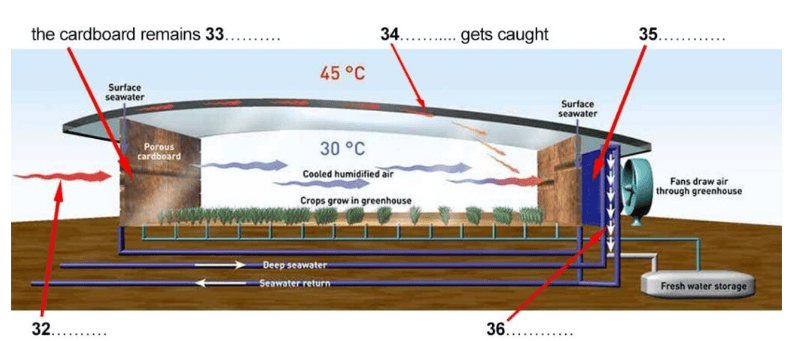
The Rainmaker
Complete the summary below using NO MORE THAN THREE WORDS from the passage. Write your answers in boxes 37-40 on your answer sheet.
The greenhouse Paton built is installed with 37………………. to keep the air flowing if the wind stands still, and it is expected in the future to rely on electricity provided solely by 38. ………………. Despite the high construction costs compared to desalination plant, the plants grown in Paton’s greenhouse need much less water, and if produced in large quantities the 39. ………………. could be reduced remarkably. In addition to all these advantages, it is also 40.………………. because it is clean and pollution free.
27 TRUE
28 NOT GIVEN
29 TRUE
30 FALSE
31 TRUE
32 Infrared light
33 Hot dry air
34 moisture
35 Condenser
36 Pure distilled water
37 fans
38 solar panels
39 costs
40 environmentally friendly
A. Đôi khi ý tưởng chỉ đơn giản xuất hiện đột ngột. Hoặc trong trường hợp của Charlie Paton, nó xuất hiện từ một cơn mưa. "Tôi đang ở trong một chiếc xe buýt ở Maroc đi qua sa mạc," anh nhớ lại. "Trời đang mưa và chiếc xe buýt đầy những con người mồ hôi nhễ nhại. Cửa sổ bị hơi nước và tôi đã đặt một chiếc khăn lên kính. Khi tôi thức dậy, chiếc khăn bị ướt. Tôi phải vắt nó. Và điều này khiến tôi tự hỏi: Sao chiếc khăn lại ướt như vậy?"
B. Đáp án, tất nhiên, là sự ngưng tụ. Trở về nhà ở London, một người bạn nhà vật lý, Philip Davies, giải thích rằng kính bị lạnh do mưa bên ngoài, đã làm lạnh không khí nóng ẩm bên trong chiếc xe buýt xuống dưới điểm sương, làm cho giọt nước tụ thành bên trong cửa sổ. Với sự tò mò, Paton - một kỹ sư điện - theo bản năng nghề nghiệp của mình - bắt đầu lắp đặt thiết bị. "Tôi làm những hệ thống ngưng tụ của mình. Tôi nghĩ rằng bạn có thể sản xuất nước như vậy ở sa mạc chỉ bằng cách làm mát không khí. Tôi tự hỏi liệu bạn có thể tạo ra đủ nước để tưới tiêu và trồng cây trồng."
C. Ngày nay, sau mười năm, giấc mơ của anh đã trở thành hiện thực với một nhà kính khổng lồ trên một hòn đảo sa mạc ngoại ô Abu Dhabi ở Vịnh Ba Tư - phiên bản đầu tiên có thể thương mại hóa của "nhà kính nước biển" của anh. Các nhà khoa học địa phương, hợp tác với Paton dưới giấy phép của công ty Light Works của anh, đang tưới tiêu trên sa mạc và trồng rau trong một thứ có thể coi là một máy làm ẩm khổng lồ tạo nước ngọt và không khí mát từ nắng và nước biển. Khi trao giải nhất trong cuộc thi thiết kế hai năm trước, Marco Goldschmied, chủ tịch Viện Kiến trúc Hoàng gia Anh, mô tả đó là "một ý tưởng thực sự độc đáo có tiềm năng ảnh hưởng đến cuộc sống của hàng triệu người sống ở các khu vực ven biển thiếu nước trên khắp thế giới."
D. Thiết kế này có ba phần chính (xem hình). Nhà kính hướng vào hướng gió thịnh hành để không khí sa mạc nóng khô thổi vào qua bức tường trước bằng những tấm bìa lỗ, được giữ ẩm và mát bởi dòng nước biển được bơm lên từ bờ biển gần đó. Nước biển đang bay hơi làm mát và làm ẩm không khí. Tháng 6 năm ngoái, ví dụ, khi nhiệt độ bên ngoài nhà kính Abu Dhabi là 46°C, bên trong chỉ là khoảng 30°C. Trong khi không khí bên ngoài khô, độ ẩm trong nhà kính là 90%. Không khí mát ẩm cho phép cây trồng phát triển nhanh hơn và vì ít nước bốc hơi từ lá, nhu cầu về nước giảm đáng kể. Cây trồng của Paton phát triển tốt với một lít nước trên mỗi mét vuông mỗi ngày, so với 8 lít nếu chúng được trồng bên ngoài.
E. Đặc điểm thứ hai cũng làm mát không khí cho cây trồng. Paton đã xây dựng một mái che hai lớp với một lớp ngoại bằng polythene trong suốt và một lớp trong được phủ một lớp phản xạ tia hồng ngoại. Ánh sáng có thể xâm nhập để tối đa hóa quang hợp, trong khi nhiệt từ tia hồng ngoại được giữ ở giữa hai lớp, cách xa cây trồng.
F. Ở phía sau nhà kính là phần thứ ba, nơi sản xuất nước chính. Ngay trước khi nhập vào thiết bị này, không khí ẩm của nhà kính hòa quyện với không khí nóng khô từ giữa hai lớp mái. Điều này có nghĩa là không khí có thể hấp thụ thêm nhiều hơi ẩm khi đi qua bức tường bằng tấm bìa ẩm thứ hai. Cuối cùng, không khí nóng bão hòa đến một bộ làm lạnh. Đây là một bề mặt kim loại được làm mát bởi thêm nước biển - tương đương với cửa sổ trên chiếc xe buýt ở Maroc của Paton. Giọt nước tinh khiết chảy vào một bể để tưới tiêu cây trồng.
G. Nhà kính hoạt động gần như tự động. Cảm biến kích hoạt mọi thứ khi mặt trời mọc và điều chỉnh dòng không khí và nước biển qua ngày dựa trên sự thay đổi về nhiệt độ, độ ẩm và ánh sáng mặt trời. Trong những ngày không có gió, quạt đảm bảo sự lưu thông không khí liên tục qua nhà kính. "Khi nó được điều chỉnh phù hợp với môi trường địa phương, bạn không cần ai đó ở đó để nó hoạt động," Paton nói. "Chúng tôi có thể vận hành toàn bộ hệ thống từ một ổ cắm 13 ampe và trong tương lai chúng tôi có thể làm cho nó hoàn toàn độc lập khỏi lưới điện khi sử dụng pin mặt trời."
H. Hiệu quả thực là làm bay hơi nước biển vào không khí nóng của sa mạc, sau đó ngưng tụ lại dưới dạng nước ngọt. Đồng thời, không khí mát ẩm chảy qua nhà kính để cung cấp điều kiện lý tưởng cho cây trồng. Chìa khóa cho tiềm năng của nhà kính nước biển là sự kết hợp độc đáo giữa việc lọc muối và điều hòa không khí. Bằng cách sử dụng năng lượng của mặt trời, nó có thể làm mát hiệu quả như một máy điều hòa không khí 500 kilowatt trong khi chỉ sử dụng dưới 3 kilowatt điện. Trong thực tế, nó làm bay hơi 3000 lít nước biển mỗi ngày và biến chúng thành khoảng 800 lít nước ngọt - đủ để tưới tiêu cây trồng. Phần còn lại bay hơi dưới dạng hơi nước.
I. Những người phê phán chỉ ra rằng chi phí xây dựng là £25 mỗi mét vuông, làm cho nước này đắt gấp đôi so với nước từ một nhà máy lọc biển thông thường. Nhưng so sánh đó rất khập khiễng, Paton nói. Hệ thống làm mát tự nhiên trong nhà kính tăng giá trị của nước đó rất nhiều. Bởi vì cây trồng chỉ cần 1/8 lượng nước so với cây trồng thông thường, nên chi phí chỉ là một phần tư so với sử dụng nước từ một nhà máy lọc biển tiêu chuẩn. Và chi phí sẽ giảm đáng kể khi sản xuất hàng loạt bắt đầu, anh chia sẻ thêm.
J. Quan trọng nhất, nhà kính có vẻ thân thiện với môi trường. "Tôi giả sử có thể có ý kiến phản đối về mặt thẩm mỹ đối với các cấu trúc lớn ở các khu vực ven biển," Harris nói, "nhưng đây là một công nghệ sạch và không tạo ra ô nhiễm hoặc thậm chí là lượng nước nóng lớn."
II. Version 2: The Rainmaker Design
The Rainmaker Design
A
Sometimes ideas just pop up out of the blue. Or in Charlie Paton's case, out of the rain. 'I was in a bus in Morocco traveling through the desert,' he remembers. 'It had been raining and the bus was full of hot, wet people. The windows steamed up and I went to sleep with a towel against the glass. When I woke, the thing was soaking wet. I had to wring it out. And it set me thinking. Why was it so wet?'
B
The answer, of course, was condensation. Back home in London, a physicist friend, Philip Davies, explained that the glass, chilled by the rain outside, had cooled the hot humid air inside the bus below its dew point, causing droplets of water to form on the inside of the window. Intrigued, Paton—a lighting engineer by profession—started rigging up his own equipment. 'I made my own solar stills. It occurred to me that you might be able to produce water in this way in the desert, simply by cooling the air. I wondered whether you could make enough to irrigate fields and grow crops.'
C
Today, a decade on, his dream has taken shape as a giant greenhouse on a desert island off Abu Dhabi in the Persian Gulf—the first commercially viable version of his 'seawater greenhouse'. Local scientists, working with Paton, are watering the desert and growing vegetables in what is basically a giant dew-making machine that produces fresh water and cool air from sun and seawater. In awarding Paton first prize in a design competition two years ago, Marco Goldschmied, president of the Royal Institute of British Architects, called it 'a truly original idea which has the potential to impact on the lives of millions of people living in coastal water-starved areas around the world'.
D
The seawater greenhouse as developed by Paton has three main parts. They both air-condition the greenhouse and provide water for irrigation. The front of the greenhouse faces into the prevailing wind so that hot dry air blows in through a front wall. The wall made of perforated cardboard kept moist by a constant trickle of seawater pumped up from ocean. The purpose is to cool and moisten the incoming desert air. The cool moist air allows the plants to grow faster. And, crucially, because much less water evaporates from the leaves, the plants need much less moisture to grow than if they were being irrigated in the hot dry desert air outside the greenhouse.
E
The air-conditioning of the interior of the greenhouse is completed by the second feature: the roof. It has two layers: an outer layer of clear polyethylene and an inner coated layer that reflects infrared radiation. This combination ensures that visible light can stream through to the plants, maximizing the rate of plant growth through photosynthesis but at the same time heat from the infrared radiation is trapped in the space between the layers, and kept away from the plants. This helps keep the air around the plants cool.
F
At the back of the greenhouse sits the third elements. This is the main water production unit. Here, the air hits a second moist cardboard wall that increases its humidity as it reaches the condenser, which finally collects from the hot humid air the moisture for irrigating the plants. The condenser is a metal surface kept cool by stilling more seawater. It is the equivalent of the window on Paton's Morcoccan bus. Drops of pure distilled water form on the condenser and flow into a tank for irrigating the crops.
G
The Abu Dhai greenhouse more or less runs itself. Sensors switch everything on when the sun rises and alter flows of air and seawater through the day in response to changes in temperature, humidity, and sunlight. On windless days, fans ensure a constant flow of air through the greenhouse. 'Once it is tuned to the local environment, you don't need anyone there for it to work,' says Paton. 'We can run the entire operation off one 13-amp plug, and in the future we could make it entirely independent of the grid, powered from a few solar panels.'
H
Critics point out that construction costs of around $4 a square foot are quite high. By illustration, however, Paton presents that it can cool as efficiently as a 500-kilowatt air conditioner while using less than 3 kilowatts of electricity. Thus the plants need only an eighth of the volume of water used by those grown conventionally. And so the effective cost of the desalinated water in the greenhouse is only a quarter that of water from a standard desalinator, which is good economics. Besides it really suggests an environmentally-friendly way of providing air conditioning on a scale large enough to cool large greenhouses where crops can be grown despite the high outside temperatures.
Do the following statements agree with the claims of the writer in Reading Passage 3? In boxes 27-31 on your answer sheet, write
YES if the statement is true
NO if the statement is false
NOT GIVEN if the information is not given in the passage
27 The idea just came to Charlie Paton by accident.
28 The bus was well ventilated.
29 After waking up, Paton found his towel was wet.
30 The fan in the bus did not work well.
31 Paton immediately operated his own business in Persian Gulf after talking with Philip Davies.
Label the diagram below.
Choose NO MORE THAN THREE WORDS from the passage for each answer. Write your answers in boxes 32-36 on our answer sheet.
Summary
Complete the summary below, using NO MORE THAN TWO WORDS from the passage for each answer.
Write your answers in boxes 37-40 on your answer sheet.
To some extent, the Abu Dhai greenhouse functions automatically. When the day is sunny, the equipment can respond to the changes in several natural elements. When there is no wind, 37 ________help to retain the flow of air. Even in the future, we have an ideal plan to power the greenhouse from 38 ________. However, there are still some critics who argue that 39 ________are not good economics. To justify himself, Paton presents favorable arguments against these critics and suggests that it is an 40 ________approach to provide air conditioning in a scale large sense.
27 YES
28 NO
29 YES
30 NOT GIVEN
31 NO
32 hot dry air
33 moist
34 heat
35 pure distilled waster
36 condenser
37 fans
38 solar panels
39 construction costs
40 environmentally-friendly
Đôi khi những ý tưởng chỉ xuất hiện bất ngờ. Hoặc trong trường hợp của Charlie Paton là từ trời mưa. Anh ấy nhớ lại: “Tôi đang ngồi trên một chiếc xe buýt ở Ma-rốc đi qua sa mạc. ‘Trời mưa và xe buýt đầy những người nóng và ướt. Các cửa sổ bốc hơi và tôi đi ngủ với một chiếc khăn tắm trên kính. Khi tôi tỉnh dậy, thứ đó đã ướt sũng. Tôi đã phải vắt nó ra. Và nó khiến tôi phải suy nghĩ. Tại sao nó lại ướt như vậy?
Tất nhiên, câu trả lời là sự ngưng tụ. Trở về nhà ở London, một người bạn là nhà vật lý, Philip Davies, giải thích rằng tấm kính, được làm lạnh bởi mưa bên ngoài, đã làm mát không khí nóng ẩm bên trong xe buýt xuống dưới điểm sương, khiến những giọt nước hình thành bên trong cửa sổ. Bị hấp dẫn, Paton - một kỹ sư ánh sáng chuyên nghiệp - bắt đầu lắp ráp thiết bị của riêng mình. ‘Tôi đã tự tạo ra các thùng lọc nước năng lượng mặt trời của riêng mình. Tôi chợt nghĩ rằng bạn có thể tạo ra nước theo cách này trong sa mạc, chỉ đơn giản bằng cách làm mát không khí. Tôi tự hỏi liệu bạn có thể kiếm đủ tiền để tưới ruộng và trồng trọt không.'
Ngày nay, một thập kỷ trôi qua, giấc mơ của ông đã thành hình với một nhà kính khổng lồ trên một hòn đảo sa mạc ngoài khơi Abu Dhabi ở Vịnh Ba Tư - phiên bản thương mại đầu tiên của 'nhà kính nước biển' của ông. Các nhà khoa học địa phương, làm việc với Paton, đang tưới nước cho sa mạc và trồng rau trong thứ về cơ bản là một cỗ máy tạo sương khổng lồ tạo ra nước ngọt và không khí mát mẻ từ mặt trời và nước biển. Khi trao giải nhất cho Paton trong một cuộc thi thiết kế hai năm trước, Marco Goldschmied, chủ tịch Viện Kiến trúc sư Hoàng gia Anh, đã gọi đó là 'một ý tưởng thực sự độc đáo có khả năng tác động đến cuộc sống của hàng triệu người sống ở vùng thiếu nước ngọt ven biển trên khắp thế giới.
Nhà kính nước biển do Paton phát triển có ba phần chính. Chúng vừa điều hòa không khí cho nhà kính vừa cung cấp nước tưới tiêu. Mặt trước của nhà kính hướng vào gió thịnh hành để không khí khô nóng thổi vào qua bức tường phía trước. Bức tường được làm bằng tấm các tông đục lỗ được giữ ẩm bằng dòng nước biển nhỏ liên tục được bơm lên từ đại dương. Mục đích là để làm mát và làm ẩm không khí sa mạc đi vào. Không khí ẩm mát cho phép cây phát triển nhanh hơn. Và điều quan trọng là do nước bốc hơi từ lá ít hơn nhiều nên cây cần ít độ ẩm hơn nhiều để phát triển so với khi chúng được tưới trong không khí sa mạc khô nóng bên ngoài nhà kính.
Điều hòa không khí bên trong nhà kính được hoàn thiện bởi tính năng thứ hai: mái nhà. Nó có hai lớp: lớp ngoài bằng polyetylen trong suốt và lớp phủ bên trong phản xạ bức xạ hồng ngoại. Sự kết hợp này đảm bảo rằng ánh sáng nhìn thấy được có thể truyền tới thực vật, tối đa hóa tốc độ phát triển của thực vật thông qua quá trình quang hợp nhưng đồng thời nhiệt từ bức xạ hồng ngoại bị giữ lại trong không gian giữa các lớp và tránh xa thực vật. Điều này giúp giữ cho không khí xung quanh cây mát mẻ.
Ở phía sau của nhà kính đặt các yếu tố thứ ba. Đây là thiết bị sản xuất nước chính. Tại đây, không khí chạm vào bức tường bìa cứng ẩm thứ hai làm tăng độ ẩm của nó khi tiếp cận thiết bị ngưng tụ, cuối cùng thiết bị này sẽ thu thập độ ẩm từ không khí nóng ẩm để gây khó chịu cho cây trồng. Bình ngưng là một bề mặt kim loại được giữ mát bằng nước biển. Nó tương đương với cửa sổ trên chiếc xe buýt Ma-rốc của Paton. Những giọt nước cất tinh khiết từ trên thiết bị ngưng tụ và chảy vào bể để tưới cây trồng.
Nhà kính Abu Dhai ít nhiều tự vận hành. Các cảm biến bật mọi thứ khi mặt trời mọc và thay đổi luồng không khí và nước biển trong ngày để đáp ứng với những thay đổi về nhiệt độ, độ ẩm và ánh sáng mặt trời. Vào những ngày không có gió, quạt đảm bảo luồng không khí liên tục đi qua nhà kính. Paton nói: “Một khi nó được chuyển sang môi trường cục bộ, bạn không cần nó ở đó nữa để nó hoạt động. "Chúng tôi có thể vận hành toàn bộ hoạt động của một phích cắm 13-amp và trong tương lai, chúng tôi có thể làm cho nó hoàn toàn độc lập với lưới điện, được cung cấp năng lượng từ một vài tấm pin mặt trời."
Các nhà phê bình chỉ ra rằng chi phí xây dựng khoảng 4 đô la một foot vuông là khá cao. Tuy nhiên, bằng hình minh họa, Paton trình bày rằng nó có thể làm mát hiệu quả như một máy điều hòa không khí 500 kilowatt trong khi sử dụng ít hơn 3 kilowatt điện. Do đó, cây trồng chỉ cần một phần tám lượng nước mà cây trồng thông thường sử dụng. Và do đó, chi phí hiệu quả của nước khử muối trong nhà kính chỉ bằng một phần tư so với nước từ máy khử muối tiêu chuẩn, rất tiết kiệm. Bên cạnh đó, nó thực sự gợi ý một cách thân thiện với môi trường để cung cấp điều hòa không khí ở quy mô đủ lớn để làm mát các nhà kính lớn, nơi có thể trồng trọt bất chấp nhiệt độ bên ngoài cao.