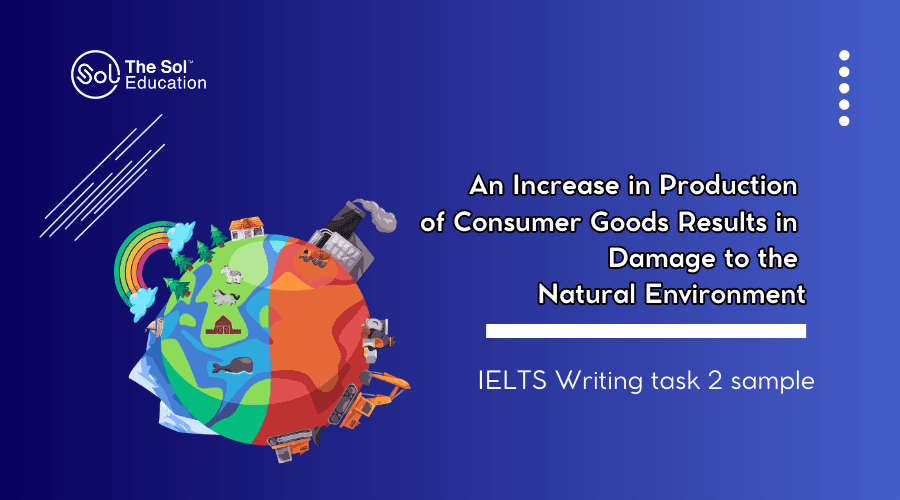
IELTS Writing task 2 sample: The increase in the production of consumer goods results in damage to the natural environment. What are the causes of this? What can be done to solve this problem?
Đề bài
The increase in the production of consumer goods results in damage to the natural environment. What are the causes of this? What can be done to solve this problem?
Phân tích đề bài và lập dàn ý
1. Phân tích đề bài
- Chủ đề: Kết hợp tiêu dùng + chủ đề môi trường;
- Dạng đề: two-part question. Ý tưởng chính của tiêu đề là sự gia tăng sản xuất hàng tiêu dùng đã dẫn đến thiệt hại về môi trường. Lý do cho tình trạng này là gì? Làm thế nào để giải quyết nó?
- Đánh giá: Là một chủ đề về môi trường nên độ khó của chủ đề này ở mức trung bình, ý tưởng và nội dung của chủ đề này không khó hình dung, bạn có thể bắt đầu từ các khía cạnh năng lượng/tài nguyên cần thiết cho sản xuất, ô nhiễm, sản xuất dư thừa sản phẩm dẫn đến lãng phí và ô nhiễm môi trường hơn nữa. Hãy nghĩ đến những vấn đề môi trường chung nhé.
2. Lập dàn ý
- Introduction: Paraphrase đề bài và trả lời ngắn gọn hai câu hỏi. 4 công cụ Paraphrase online FREE dành cho dân IELTS
- Body 1: Nêu nguyên nhân gây ra thiệt hại về môi trường do tăng cường hoạt động sản xuất. Chúng bao gồm nhu cầu về tài nguyên ngày càng tăng, ô nhiễm gia tăng và xử lý sản phẩm dư thừa.
- Body 2: Đưa ra giải pháp. Chính phủ cần xây dựng chính sách hạn chế hành vi sản xuất của doanh nghiệp. Cần nâng cấp thêm thiết bị sản xuất để đạt được sản xuất xanh và giảm sử dụng năng lượng. Người tiêu dùng cần nhận thức được hậu quả hành động của mình và tiêu dùng hợp lý hơn.
- Conclusion: Cho biết tác hại đối với môi trường là rất lớn và cần phải thực hiện hành động để giải quyết nó.
Bài mẫu tham khảo
Manufacturing activities have been expanding in recent years to promote consumption. However, such expansion has taken its toll on the environment. There are various reasons for this problem and measures are required to solve it.
As modern consumers are increasingly obsessed with material enjoyment, the rising demand pushes companies to scale up their production for more profit. This development gives rise to the exploitation of natural resources and the generation of pollution in many forms, which would exacerbate the already severe environmental problems. For instance, the rising supply of meat and dairy products is directly responsible for climate change as livestock is a significant source of greenhouse gas emissions. Apart from that, manufacturing other consumer goods such as clothing and appliances entails the usage of chemicals that can pollute nature. Also, the surplus stock would also be a considerable environmental concern because it is often discarded, ending up in landfill sites or other random places to have a repercussion on wildlife that inhabits there.
To solve this problem, concerted efforts from governments, businesses, and individuals are necessary. It is vitally important for governments to introduce policies to regulate industrial production, requiring companies to shoulder the social responsibility of minimizing pollution and carbon emission. Additionally, more attention should be paid to updating machinery and equipment for green production and recycling, which could not only reduce environmental impacts but also contribute to a country’s sustainable development in the long run. Finally, consumers should understand the impacts of consumerism and make sensible purchasing decisions. Efforts such as opting for durable goods and supporting environmental-friendly products could be conducive to environmental protection.
In conclusion, manufacturing more consumer goods could be detrimental in many aspects, and measures from various sides should be implemented for the sake of nature and human beings.
(297 words)
Từ vựng IELTS đáng chú ý
- Obsessed with (collocation): Mê mải với.
- Rising demand (collocation): Sự tăng nhu cầu.
- Scale up (collocation): Mở rộng quy mô, gia tăng quy mô.
- Exploitation (n): Sự khai thác.
- Natural resources (collocation): Tài nguyên thiên nhiên.
- Generation of (collocation): Sự tạo ra.
- Severe (adj): Nghiêm trọng, nặng nề.
- Climate change (collocation): Biến đổi khí hậu.
- Greenhouse gas emissions (collocation): Khí thải nhà kính.
- Consumer goods (collocation): Hàng tiêu dùng.
- Entails (v): Đòi hỏi, bao gồm.
- Surplus stock (collocation): Hàng tồn kho dư thừa.
- Environmental concern (collocation): Vấn đề môi trường.
- Landfill sites (collocation): Khu vực chôn lấp rác thải.
- Repercussion (n): Tác động, hậu quả.
- Concerted efforts (collocation): Nỗ lực đồng lòng, nỗ lực chung.
- Regulate (v): Quy định, điều chỉnh.
- Social responsibility (collocation): Trách nhiệm xã hội.
- Minimizing (v): Giảm tối thiểu, làm giảm nhẹ.
- Carbon emission (collocation): Khí thải carbon.
- Environmental-friendly (adj): Thân thiện với môi trường.
- Conducive (adj): Có ích, đóng góp.
- Sustainable development (collocation): Phát triển bền vững.
- For the sake of (collocation): Vì lợi ích của.
Đọc thêm các bài viết khác liên quan đến Environment: