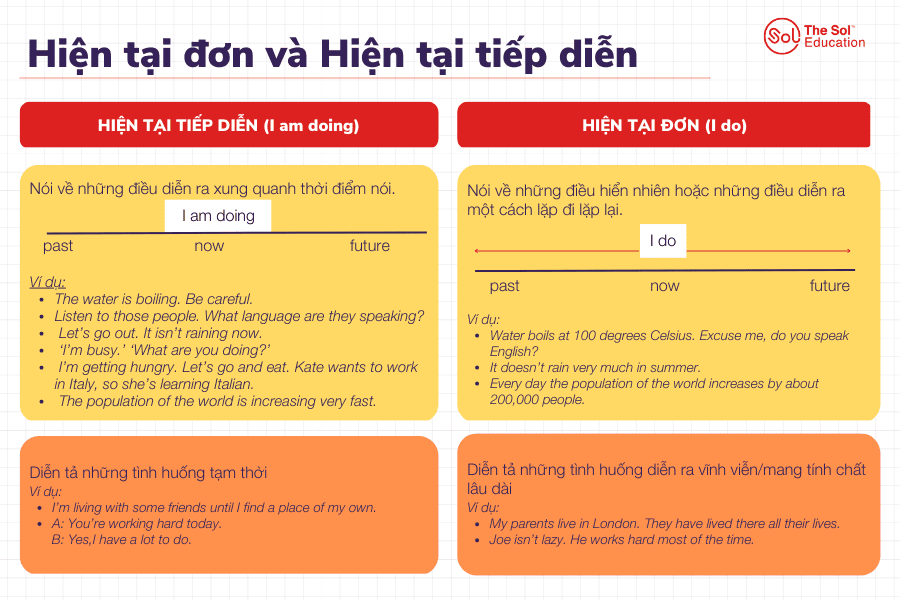
Bạn đã biết cách sử dụng thì hiện tại đơn và hiện tại tiếp diễn mà không bị nhầm lẫn? Trường hợp nào dùng thì hiện tại đơn, trường hợp nào dùng thì hiện tại tiếp diễn? Có trường hợp nào dùng được cả 2 thì này chưa? Hãy cùng SOL tìm hiểu nhé.
Chúng ta hãy cùng phân biệt Hiện tại tiếp diễn và Hiện tại đơn thông qua bảng so sánh dưới đây:
Always do | Be always doing |
I always do something = I do it every time (tôi làm nó mọi lúc) | I’m always doing something = I do it too often or more often than normal. (Tôi làm nó rất thường xuyên hoặc làm nhiều hơn bình thường) |
Ví dụ: - I always go to work by car. (Tôi luôn luôn đi làm bằng xe hơi) (mà không dùngI’m always going) | Ví dụ: - I’ve lost my keys again. I’m always losing them. (Tôi lại mất chìa khóa lần nữa. Tôi luôn luôn làm mất chúng). - I’m always losing them = I lose them too often, or more often than normal. |
Ví dụ:
Chúng ta sử dụng dạng tiếp diễn (raining, waiting…) cho những hành động và sự việc đã bắt đầu nhưng chưa kết thúc. Một số động từ như know, like… lại không được sử dụng theo cách này. Chúng ta không thể nói “I am knowing”, “they are liking” mà chỉ được dùng “I know”, “they like”.
Một số động từ trong bảng dưới đây THƯỜNG KHÔNG được sử dụng ở thì hiện tại tiếp diễn:
like want need prefer |
know realise understand recognise |
believe suppose remember mean |
belong fit contain consist seem |
Ví dụ:
Động từ “think” thường được sử dụng với 2 nghĩa sau:
“Think” mang nghĩa “tin rằng” “có ý kiến”. Với nghĩa này, chúng ta không sử dụng thì tiếp diễn. | “Think” mang nghĩa “suy nghĩ”, "cân nhắc". Với nghĩa này chúng ta có thể sử dụng thì tiếp diễn. |
Động từ tri nhận là động từ chỉ sự nhận thức của con người về sự vật, hiện tượng bằng các giác quan như: See (nhìn), notice (chú ý), watch (xem), listen (nghe), hear (nghe), feel (cảm giác), touch (chạm), smell (ngửi thấy), taste(nếm).
Chúng ta thường sử dụng thì hiện tại đơn với các động từ see/hear/smell/taste mà không sử dụng thì tiếp diễn.
Ví dụ:
- Do you see that man over there? (Bạn có nhìn thấy người đàn ông ở đằng kia không) (notareyouseeing)
- The room smells. Let’s open a window. (Căn phòng đang bốc mùi. Hãy mở cửa sổ ra)
- This soup doesn’t taste very good. (Món súp này không ngon lắm)
Trong khi đó, chúng ta có thể sử dụng cả thì hiện tại đơn và hiện tại tiếp diễn với “look”, “feel” dể diễn tả cách ai đó nhìn hoặc cảm nhận.
Ví dụ:
- You look well today. or You’re looking well today. (Hôm nay trông bạn rất khỏe khoắn).
- How do you feel now? or How are you feeling now? (Bây giờ bạn cảm thấy như thế nào?)
*Lưu ý: I usually feel tired in the morning.(Tôi thường cảm thấy mệt vào buổi sáng) (không dùng I’m usually feeling)
Chúng ta sử dụng cấu trúc am/is/are being (he’s being…, you’re being… etc) để nói về cách ai đó cư xử ở thời điểm hiện tại. Ví dụ:
- I can’t understand why he’s being so selfish. He isn’t usually like that. (Tôi không thể hiểu được tại sao anh ấy lại trở nên ích kỉ. Anh ấy không thường như vậy.
(being selfish = behaving selfishly now)
Câu trên khác với: He never thinks about other people. He’s very selfish. (Anh ấy chưa bao giờ nghĩ đến người khác. Anh ấy rất ích kỉ) – câu này nói về việc anh ấy bản chất là một người ích kỉ, không chỉ ở thời điểm hiện tại.
- ‘The path is icy. Don’t slip.’ (Con đường này rất trơn, đừng trượt).
‘Don’t worry. I’m being very careful.’ (Đừng lo, tôi đang rất cẩn thận).
Câu này diễn tả việc người nói đang cần thận ở thời điểm hiện tại. Khác với câu I don’t like to take risks. I’m a very careful person. (Tôi không thích mạo hiểm. Tôi là một người rất cẩn trọng,) diễn tả việc người nói luôn luôn cẩn thận mọi lúc, mọi việc, không chỉ trong tình huống đang nói.
Are the underlined verbs OK? Correct them where necessary.
1 Water boils at 100 degrees Celsius. 2 How often are you going to the cinema? 3 Ben tries to find a job, but he hasn’t had any luck yet. 4 Martina is phoning her mother every day. 5 The moon goes round the earth in about 27 days. 6 Can you hear those people? What do they talk about? 7 What do you do in your spare time? 8 Sarah is a vegetarian. She doesn’t eat meat. 9 I must go now. It gets late. 10 ‘Come on! It’s time to leave.’ ‘OK, I come.’ 11 Paul is never late. He’s alwaysstarting work on time. 12 They don’t get on well. They’re always arguing. | 1 OK 2 Do you go |
Put the verb into the correct form, present continuous or present simple.
1
a I usually get  (I / usually / get) hungry in the afternoon.
b, I’m getting  (I / get) hungry. Let’s go and eat something.
2
a, “………………………………………. (you/listen) to the radio?” “No, you can turn it off”.
b, “………………………………………. (you/listen) to the radio a lot?” “No, not very often”.
3.
a, The River Nile ………………………………………………. (flow) into the Mediterranean.
b, The river ………………………………………………………..(flow) very fast today – much faster than usual.
4.
a, I’m not very active. ………………………………………………. (I/not/do) any sport.
b, What ……………………………………………………………… (you/usually/do) at weekends?
5.
a, Rachel is in New York right now. 
 ………………………………………….. (She / stay) at the Park Hotel.
b, ……………………………………………………… (She / always / stay) there when she’s in New York.
1 Why are all these people here? …..What’s happening…. (What / happen)?
2 Julia is good at languages. ………………………………………………… (She / speak) four languages very well.
3 Are you ready yet? ………………………………………………… (Everybody / wait) for you.
4 I’ve never heard this word. How ………………………………………… (you pronouce) it?
5 Kate ………………………………………………… (not/work) this week. She’s on holiday.
6 I think my English ………………………………………………… (improve) slowly. It’s better than it was.
7 Nicola ………………………………………………… (live) in Manchester. She has never lived anywhere else.
8 Can we stop walking soon? ………………………………………………… (I/start) to get tired.
9 Sam and Tina are in Madrid right now. ………………………………………………… (They/visit) a friend of theirs.
10 “What ………………………………………………… (your father/do)?” “He is an architecht”.
11 It took me an hour to het to work this morning. Most days ………………………………………………… (it/not/take) so long.
12. ………………………………………………… (I/learn to drive). My driving test is next month. My father ………………………………………………… (teach) me.
Finish B’s sentences. Use always -ing.
1 A: I’ve lost my keys again.
B: Not again! ……You’re always losing your keys…..
2 A: The car has broken down again.
B: That car is useless. It …………………………………………………
3 A: Look! You’ve made the same mistake again.
B: Oh no, not again! I …………………………………………………
4 A: Oh, I’ve left my phone at home again.
B: Typical! ……………………………………………………
Put the verb into the correct form, present continuous or present simple.
1 Are you hungry? ….Do you want….(you / want) something to eat?
2 Alan says he’s 90 years old, but nobody…………………………………………(believe) him.
3 She told me her name, but ………………………………………… (I/not/remember) it now.
4 Don’t put the dictionary away. …………………………………………………… (I / use) it.
5 Don’t put the dictionary away. …………………………………………………… (I / need) it.
6 Air …………………………………………………… (consist) mainly of nitrogen and oxygen.
7 Who is that man? What …………………………………………………… (he / want)?
8 Who is that man? Why …………………………………………………… (he / look) at us?
9 Who is that man? …………………………………………………… (you / recognise) him?
10 …………………………………………………… (I / think) of selling my car. Would you be interested in buying it?
11 I can’t make up my mind. What …………………………………………………… (you / think) I should do?
12 Gary wasn’t well earlier, but …………………………………………………… (he/seem) OK now.
Are the underlined verbs OK? Correct them where necessary.
1 Nicky is thinking of giving up her job. 2 It’s not true. I’m not believing it. 3 I’m feeling hungry. Is there anything to eat? 4 I’ve never eaten that fruit. What is it tasting like? 5 I’m not sure what she does. I think she works in a shop. 6 Look over there. What are you seeing? 7 You’re very quiet. What are you thinking about? | 1 OK 2 I don’t believe it. |
Complete the sentences. Use is/are being (continuous) or is/are (simple).
1 I can’t understand why …….. he’s being…… so selfish. He isn’t usually like that.
2 You’ll like Sophie when you meet her. She …………………………………………………… very nice.
3 Sarah ………………………………………… very nice to me at the moment. I wonder why.
4 They …………………………………………………… very happy. They’ve just got married.
5 You’re normally very patient, so why ……………………………………………so unreasonable about waiting ten more minutes?
6 Would you like something to eat? …………………………………………………… hungry?
3 is trying
4 phones
5 OK
6 are they talking
7 OK
8 OK
9 It’s getting / It is getting
10 I’m coming / I am coming
11 He always starts
12 OK
2 a Are you listening
b Do you listen
3 a flows
b is flowing / ’s flowing
4 a I don’t do
b do you usually do
5 a She’s staying / She is staying
b She always stays
2 She speaks
3 Everybody’s waiting / Everybody is
waiting
4 do you pronounce
5 isn’t working / is not working / ’s not
working
6 is improving
7 lives
8 I’m starting / I am starting
9 They’re visiting / They are visiting
10 does your father do
11 it doesn’t take
12 I’m learning / I am learning …
is teaching / ’s teaching
2 It’s always breaking down.
3 I’m always making the same
mistake. / … that mistake.
4 You’re always leaving your
phone at home.
2 believes
3 I don’t remember / I do not
remember or I can’t remember
4 I’m using / I am using
5 I need
6 consists
7 does he want
8 is he looking
9 Do you recognise
10 I’m thinking / I am thinking
11 do you think
12 he seems
3 OK (I feel is also correct)
4 does it taste
5 OK
6 do you see
7 OK
2 ’s / is
3 ’s being / is being
4 ’re / are
5 are you being
6 Are you