Ngữ pháp Tiếng Anh - Cùng SOL tìm hiểu về câu bị động trong Tiếng Anh cũng như cách chuyển từ câu chủ động sang câu bị động. Kèm theo đó là các dạng bài tập thực hành để nhuần nhuyễn câu bị động nhé.

This house was built in 1981. ‘This house was built’ là dạng bị động.
Xét ví dụ câu chủ động và câu bị động đưới dây:
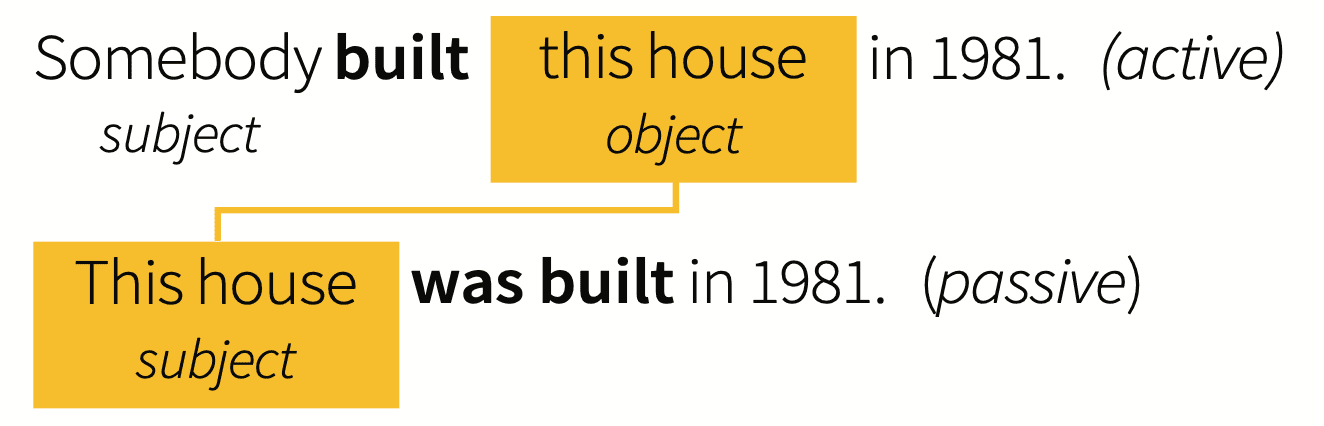
Chúng ta dùng động từ chủ động khi nói chủ ngữ làm gì đó. Ví dụ:
- My grandfather was a builder. He built this house in 1981. (Ông tôi là một thợ xây. Ông đã xây căn nhà này vào năm 1981).
- It’s a big company. It employs two hundred people. (Đó là một công ty lớn. Nó sử dụng 200 nhân viên).
Chúng ta dùng động từ bị động để nói về điều gì đó xảy ra/ tác động với chủ ngữ. Ví dụ:
- ‘How old is this house?’ ‘Itwas built in 1981.’ (Căn nhà này được xây bao nhiêu năm rồi? Nó được xây dựng vào năm 1981).
- Two hundred people are employed by the company. (Hai trăm người được tuyển dụng bởi công ty).
Khi chúng ta sử dụng thể bị động, ai hoặc cái gì gây ra hành động thường không được biết hoặc không quan trọng. Ví dụ:
- A lot of money was stolen in the robbery (Một số tiền lớn đã bị cướp trong vụ trộm). – Ở đây, ai đó đã trộm nó nhưng chúng ta không biết là ai.
- Is this room cleaned everyday? (Căn phòng có được dọn dẹp hàng ngày không?) – Có ai dọn dẹp căn phòng không, không quan trọng là ai dọn.
Nếu chúng ta muốn nói ai làm hoặc điều gì gây ra hành động, chúng ta sử dụng “by” như sau:
- This house was built by my grandfather. (Căn nhà này được xây dựng bởi ông của tôi).
- Two hundred people are employed by the company. (Hai trăm người được tuyển dụng bởi công ty).
Chúng ta có cấu trúc câu bị động như sau:
| Subject + be + V3/ed + (by + doer) + (…). |
* Trong đó:
+ Subject: đối tượng bị tác động bởi hành động
+ be + V3/ed: ‘be’ thay đổi tùy theo thì dùng trong câu chủ động
+ V3/ed luôn giữ nguyên dạng. Thứ thay đổi theo thì là động từ ‘be’ như trên.
+ (by + doer): ‘by’ có nghĩa là “bởi”, dùng để giới thiệu đối tượng thực hiện hành động đứng sau ‘by’.
‘doer’ chỉ đối tượng thực hiện hành động.
‘by + doer’ được đặt trong (…) vì sẽ có những trường hợp ta có thể lược bỏ phần này.
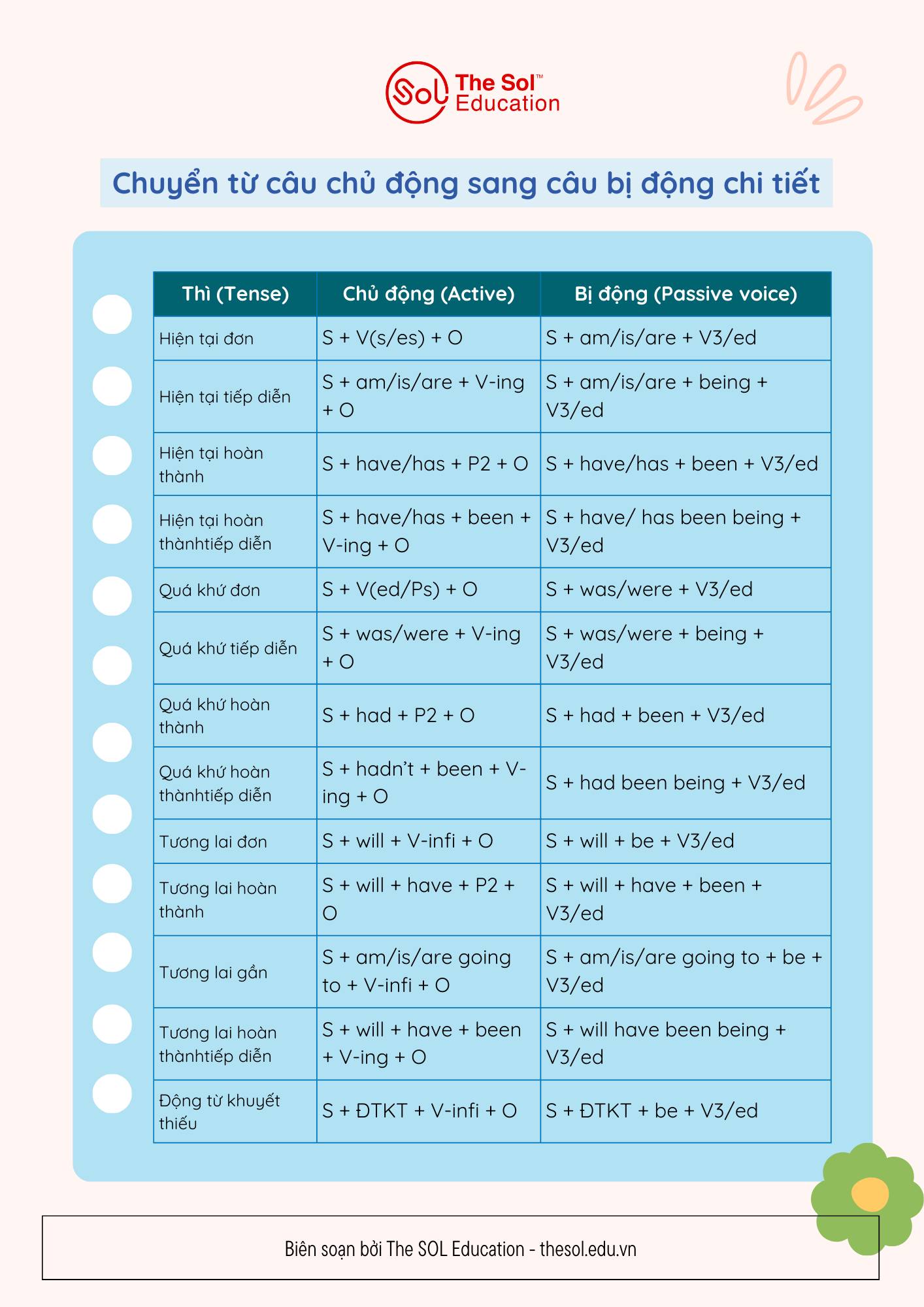
Dưới đây là công thức chuyển từ câu chủ động sang câu bị động chi tiết:
- Thể chủ động: To V - (to) do/clean/see etc.
- Thể bị động: To be + V3/ed - (to) be + done/cleaned/seen etc.

Ví dụ:
- Thể chủ động: (to) have + done/cleaned/seen etc.
- Thể bị động: (to) have been + done/cleaned/seen etc.
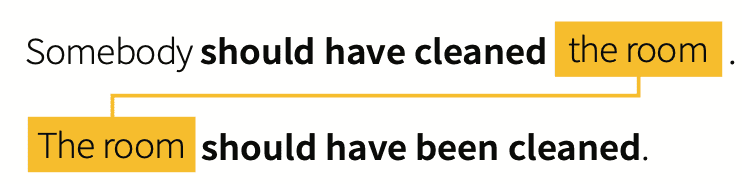
Ví dụ:
- Chủ động: S + V(s/es)
- Bị động: S + to be + V3/ed
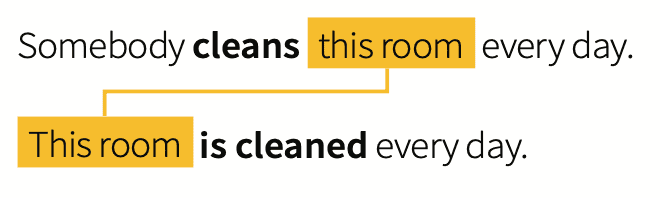
Ví dụ:
- Thể chủ động: cleaned/saw etc.
- Thể bị động: was/were + cleaned/seen etc.
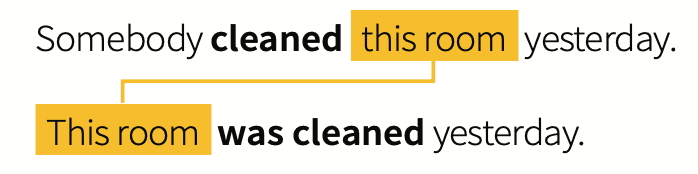
Ví dụ:
- Thể chủ động: have/has + done etc.
- Thể bị động: have/has been + done etc.
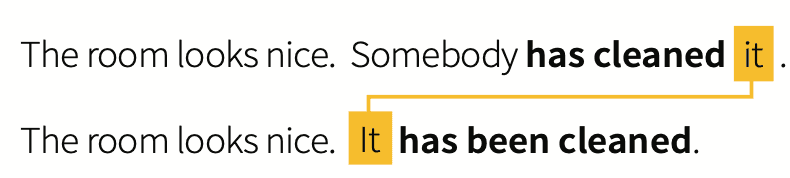
Ví dụ:
- Thể chủ động: had + done etc.
- Thể bị động: had been + done etc.

Ví dụ:
- Thể chủ động: am/is/are + (do)ing
- Thể bị động: am/is/are + being (done)
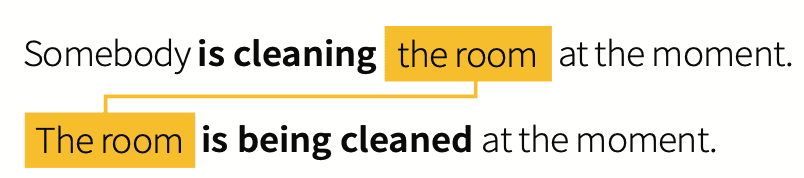
Ví dụ:
- Thể chủ động: was/were + (do)ing
- Thể bị động: was/were + being (done)

Ví dụ:
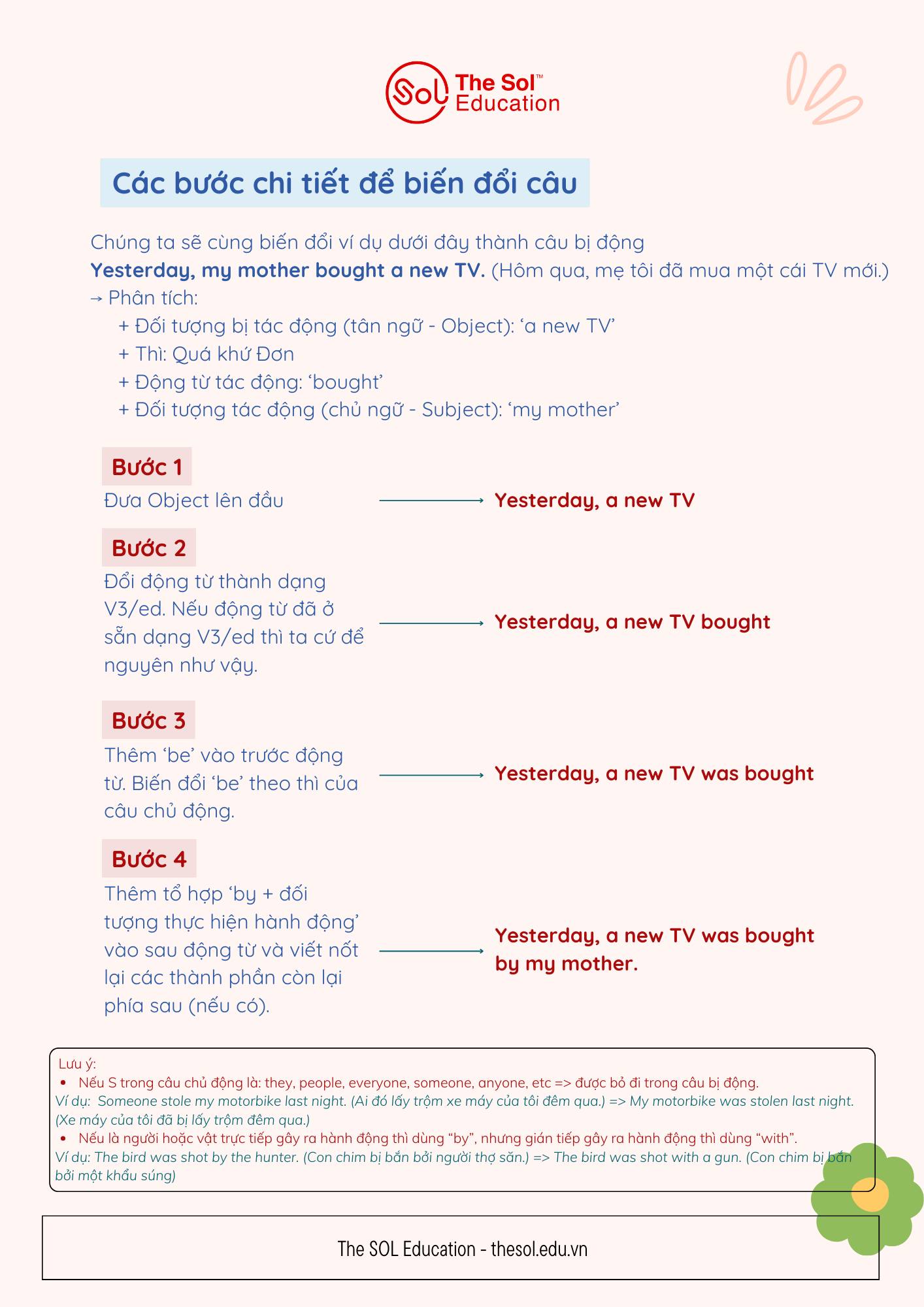
Chúng mình hãy theo dõi các bước như sau nhé:
Complete the sentences. Use these verbs in the correct form, present or past:
cause damage find hold injure make
invite surround own send show overtake
1 Many accidents ……are caused……. by careless driving.
2 Cheese …………………………………………. from milk.
3 The roof of the building …………………………………………. in a storm a few days ago.
4 A cinema is a place where films …………………………………………. .
5 You …………………………………………. to the party. Why didn’t you go?
6 This plant is very rare. It …………………………………………. in very few places.
7 Although we were driving fast, we …………………………………………. by a lot of other cars.
8 In the US, elections for president …………………………………………. every four years.
9 There was an accident last night, but fortunately nobody ………………………………… .
10 You can’t see the house from the road. It …………………………………………. by trees.
11 I never received the letter. It …………………………………………. to the wrong address.
12 The company I work for …………………………………………. by a much larger company.
Put the verb into the correct form, present or past, active or passive.
1
a Two hundred people ….are employed…. (employ) by the company.
b The company ….employs… (employ) 200 people.
2
a Water ……………………(cover) most of the earth’s surface.
b How much of the earth’s surface ………………… (cover) by water?
3
a While I was on holiday, my camera …………………… (steal) from my hotel room.
b While I was on holiday, my camera …………………… (disappear) from my hotel room.
4
a Robert’s parents ……………………(die) when he was very young.
b Robert and his sister …………………… (bring up) by their grandparents.
5
a The boat hit a rock and …………………… (sink) quickly.
b Fortunately everybody …………………… (rescue).
6
a Bill …………………… (fire) from his job. He wasn’t very good at it.
b Sue …………………… (resign) from her job because she didn’t enjoy it any more.
7
a It can be noisy living here, but it …………………… (not / bother) me.
b It can be noisy living here, but I …………………… (not / bother) by it.
8
a Maria had an accident. She …………………… (knock) off her bike.
b Maria had an accident. She …………………… (fall) off her bike.
9
a I haven’t seen these flowers before. What …………………… (they / call)?
b I haven’t seen these flowers before. What …………………… (you / call) them?
Instead of using somebody, they, people etc., write a passive sentence.
1 Somebody cleans the room every day.
2 They cancelled all flights because of fog.
3 Somebody accused me of stealing money.
4 How do you use this word?
5 The price includes all taxes.
6 People warned us not to go out alone.
7 We don’t use this office any more.
8 They invited five hundred people to the wedding.
1 The room is cleaned every day .
2 All . …………………………….
3 …………………… money.
4 How …………………… used?
5 All …………………… in the price.
6 We…………………….
7 This …………………… .
8 Five hundred ……………………
Complete these sentences. Use the following verbs in the passive:
arrest carry cause delay do forget keep knock know make repair send
Sometimes you need have (might have, would have etc.).
1 The situation is serious. Something must …….. be done…… before it’s too late.
2 I haven’t received the letter yet. It might ….. have been sent….. to the wrong address.
3 A decision will not …………………………….. until the next meeting.
4 These documents are important. They should always ……………………………. in a safe place.
5 This road is in bad condition. It should ……………………………. a long time ago.
6 The injured man couldn’t walk and had to …………………………….
7 If you hadn’t shouted at the policeman, you wouldn’t …………………………….
8 I’m not sure what time I’ll arrive tomorrow. I may …………………………….
9 It’s not certain how the fire started. It might ……………………………. by an electrical fault.
10 A new school is being built. The old one is going to ……………………………. down.
11 The election is next Sunday. The full results will ……………………………. onTuesday.
12 Last week they weren’t speaking to one another. Now they’re happy again. The problem seems to …………………………….
Make sentences from the words in brackets. Sometimes the verb is active, sometimes passive.
1 There’s somebody behind us. (We / follow) …We’re being followed….
2 This door is a different colour, isn’t it? (you / paint?) …Have you painted it?.....
3 My bike has disappeared. (It / steal!) It …………………………….
4 My umbrella has disappeared. (Somebody / take) Somebody …………………………….
5 A neighbour of mine disappeared six months ago.
(He / not / see / since then) He …………………………….
6 I wonder how Jessica is these days.
(I / not / see / for ages) I …………………………….
7 A friend of mine was stung by a bee recently.
(you / ever / sting / bee?) ……………………………. you …………………………….
8 Thebridgewasdamagedrecently.
(It / repair / at the moment) It …………………………….
9 Tom’s car was stolen recently.
(It / not / find / yet) …………………………….
10 I went into the room and saw that the table and chairs were not in the same place.
(The furniture / move) The …………………………….
Instead of using ‘somebody’, ‘they’ etc., write a passive sentence.
1 Somebody has cleaned the room.
The ……………………………. room has been cleaned .
2 They are building a new road around the city.
A ……………………………. around the city.
3 They have built two new hotels near the airport.
Two ……………………………. near the airport
4 When I last visited, they were building some new houses here.
When I last visited, some …………………………….
5 The meeting is now on 15 April. They have changed the date.
The date of …………………………….
6 I didn’t know that somebody was recording our conversation.
I didn’t know that our …………………………….
7 Is anyone doing anything about the problem?
……………………………. anything ……………………………. the problem?
8 The windows were very dirty. Nobody had cleaned them for ages.
The windows were very dirty. They …………………………….
Luyện tập 1
2 hope
3 wish
4 wished
5 hope
6 wish
7 hope
Luyện tập 2
2 I wish she would come. or… would hurry up.
3 I wish somebody would give me a job.
4 I wish the/that dog would stop barking.
5 I wish you wouldn’t drive so fast.
6 I wish you wouldn’t leave the door open (all the time).
7 I wish people wouldn’t drop litter in the street.
Luyện tập 3
3 I knew
4 we hadn’t gone
5 the bus would come
6 I could come
7 it was/were
8 I’d taken / I had taken
9 you’d listen / you would listen
10 you wouldn’t complain or you didn’t complain
11 it wasn’t/weren’t
12 the weather would change
13 I had / I could have
14 we could have stayed
Luyện tập 4
2 is made
3 was damaged
4 are shown
5 were invited
6 ’s/is found
7 were overtaken
8 are held
9 was injured
10 is surrounded
11 was sent
12 is owned
Luyện tập 5
2 a covers
b is covered
3 a was stolen
b disappeared
4 a died
b were brought up
5 a sank
b was rescued
6 a was fired
b resigned
7 a doesn’t bother
b ’m/am not bothered
8 a was knocked
b fell
9 a are they called
b do you call
Luyện tập 6
2 All flights were cancelled because of fog.
3 I was accused of stealing money.
4 How is this word used?
5 All taxes are included in the price.
6 We were warned not to go out alone.
7 This office isn’t / is not used any more.
8 Five hundred people were invited to the wedding
Chúc các bạn nắm rõ ngữ pháp IELTS về phần câu bị động nhé.