Buy
Cách trả lời các dạng câu hỏi IELTS Speaking part 3 từ A-Z
Loading...

Cách trả lời các dạng câu hỏi IELTS Speaking part 3 từ A-Z

Phần thi IELTS Speaking part 3 có thể nói là khó nhất trong bài thi IELTS Speaking. Để giúp các bạn có thể chuẩn bị tốt hơn cho phần thi này, chúng ta hãy cùng phân loại các câu hỏi Speaking part 3 và cách trả lời cho từng dạng câu hỏi trong bài viết này cùng SOL IELTS nhé. 
Mở/Đóng

    Phần thi IELTS Speaking part 3 có thể nói là khó nhất trong bài thi IELTS Speaking. Để giúp các bạn có thể chuẩn bị tốt hơn cho phần thi này, chúng ta hãy cùng phân loại các câu hỏi Speaking part 3 và cách trả lời cho từng dạng câu hỏi trong bài viết này cùng SOL IELTS nhé. 

    Chúng ta có thể phân loại các câu hỏi trong IELTS Speaking part 3 thành một số dạng chính sau:

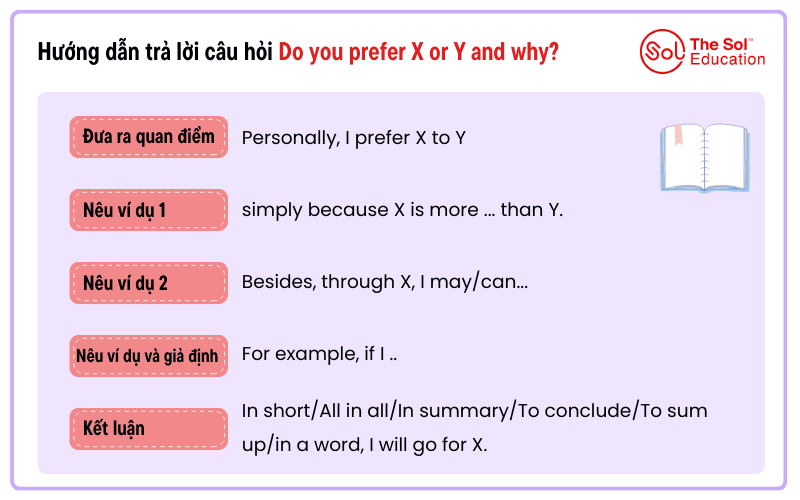
    1. Câu hỏi yêu cầu đưa ra lựa chọn - Do you prefer X or Y and why?

    Để trả lời các câu hỏi trong Speaking part 3, chúng ta có thể trình bày các ý của mình theo 6 bước:

    • Đưa ra quan điểm
    • Nêu lý do
    • Nêu ví dụ
    • Nêu giả định
    • Đề cập mặt đối lập của vấn đề
    • Kết luận

    Các bước trên có thể diễn giải như sau:


    Một số câu hỏi điển hình cho dạng câu hỏi này: 

    • Do you prefer eating at home or at restaurants? 
    • Which one is the most important, your relatives or neighbours?
    • Do you prefer reading newspaper or watching TV programmes?
    • Do you prefer travelling alone or with other people?
    • What do you prefer, a high salary or job satisfaction?
    • Do you prefer making a call or writing a letter? 
    • Do you prefer watching foreign films or Vietnamese films?
    • Do you prefer several short holidays or a long holiday?

    2. Câu hỏi về tầm quan trọng - Is/Are... important? 

    Để trả lời câu hỏi dạng này, bạn hãy trả lời trực tiếp nội dung câu hỏi. Bạn có thể dùng các cấu trúc giả định khi giải thích: rất quan trọng vì nếu không có, chúng ta sẽ... 

    • Yes, definitely yes, I always believe that X is really essential and necessary for.... 
    • since without (doing) X, we would... (hậu quả) 
    • Besides, ... 
    • So, obviously, there is no doubt about the significance of (doing) X. 

    Các câu hỏi điển hình dạng này: 

    • Are computers important? 
    • Is art important? 
    • Is protecting animals important? 
    • Is doing outdoor activities important? 
    • Is reading important? 

    3. Câu hỏi về sự phổ biến - What is/are the most popular in your country? 

    Với câu hỏi What is/ are the most popular ... in your country?, bạn không nên trả lời ngay sự vật, sự việc nào đó là phổ biến nhất ở nước mình. Cách trả lời cho câu hỏi trên là chia người dân trong nước thành 2 nhóm và trình bày sự khác biệt rõ ràng về sở thích giữa 2 nhóm người này.

    Ví dụ: 

    • young people and the elderly / older people (âm nhạc, thể thao, phim ảnh, địa điểm tham quan du lịch...) 
    • men and women (cách thức giải trí, việc mua sắm...) 
    • children and adults (thói quen đọc sách báo, loại thông tin muốn biết...) 
    • students and office workers (sử dụng máy tính/ điện thoại di động, việc mua sắm...)
    • Northern Vietnamese and Southern Vietnamese people (món ăn chính...) 

    Bạn có thể trả lời câu hỏi trên theo trình tự sau: 

    It depends. (Vấn đề này tùy trường hợp) 

    For X (đối với một nhóm người), 
    I believe that they have a fancy for ... 
    (giới thiệu khái quát) 
    such as ... (nêu ví dụ) 
    simply because... 
    Yet, for Y (nhưng đối với nhóm người khác), 
    I guess they tend to like ... 
    (giới thiệu khái quát) including ... (nêu ví dụ) 
    That's probably because... 


    Cách trả lời 

    Chia người dân trong nước – chủ thể thực hiện hành động liên quan đến sự vật, sự việc... được nêu trong câu hỏi - thành 2 nhóm (theo tuổi tác, giới tính...), trình bày loại / những sự vật, sự việc... mà mỗi nhóm yêu thích và loại những sự vật, sự việc... được cả 2 nhóm yêu thích. 

    It depends. 

    For X, I believe that... is the most popular one for them, such as A, B, C, D, simply because ... 

    Yet, for Y, I guess they tend to choose..., including A, B, C, D. That's probably because... 

    Meanwhile, there are... that are welcomed by all..., like... 

    Các câu hỏi điển hình dạng này:

    • What is the most popular way of relaxing for Vietnamese people?
    • What are the most popular travel destinations for Vietnames people? 
    • What is the most popular sport in your country? 
    • What is the most common accommodation in your country? 
    • What is the most favorite music in your country?

    Gợi ý trả lời một số câu hỏi điển hình:

    Câu hỏiTrả lời gợi ý
    What is the most popular sport in your country? 

    Well, it depends. 
    For young people, I believe that ball games are their most favourite sports, like basketball, soccer, tennis. 
    Yet, for the elderly/older people, I guess they may have a fancy for some more relaxing sports, such as jogging, walking, or doing yoga. 

    Meanwhile, there are some sports that are welcomed by all age groups, like table tennis, 
    swimming, and cycling. 

    What is the most favourite music in your country? Well, it depends. 
    For young people, I am sure they are in favour of popular music, for example, pop, rock, hip hop, fusion, funk, and stuff like that. 
    Yet, for the elderly/older people, I suppose they are fond of more relaxing music, such as country and classical music. 
    At the same time, some types of music are universally loved by all people, like light music and folk music. 


    4. Câu hỏi về sự khác biệt - What are the differences between X and Y? 

    Cách trả lời: 

    Để trả lời câu hỏi trên, bạn cần: 

    • tìm những điểm khác nhau giữa X và Y. Ví dụ, khi được hỏi về sự khác biệt giữa 2 thành phố, bạn có thể trình bày những điểm khác biệt xét từ các khía cạnh như: quy mô của thành phố, cơ sở hạ tầng, tình trạng giao thông, chất lượng không khí, chi phí sinh hoạt, áp lực của cuộc sống, nhịp sống, cơ hội nghề nghiệp, v.v. 
    • dùng các từ/cụm từ diễn tả sự so sánh, từ trái nghĩa 
      • Unlike X, Y tends to (từ/cụm từ diễn tả sự so sánh) 
      • X is ..., while Y is more likely to ... (từ trái nghĩa)
      • Compared with X, Y is less likely to ... 

    Các câu hỏi điển hình cho dạng này:

    • What are the differences between men and women when considering relaxation?
    • What are the differences between men's and women's shopping habit? 
    • What are the differences between big shops and small shops? 
    • What are the differences between living in big cities and living in small cities? 
    • What are the differences between living in a big family and living in a small family? 
    • What are the differences between young people and the elderly/older people in ways of expressing anger? 
    • What are the differences between single-player sports and team sports? 
    • What are the differences between watching sport live and watching sport on TV? 
    • What are the differences between big weddings and smalls wedding? 
    • What are the differences between Vietnamese films and foreign films? 
    • What are the differences between self-teaching and being taught by teachers? 

    Gợi ý trả lời một số câu hỏi:

    Câu hỏiGợi ýSample answer
    What are the differences between big shops and small shops? Bạn có thể nêu những điểm khác biệt giữa 2 loại cửa hàng này xét về quy mô, uy tín, số lượng / chất lượng hàng hóa, giá cả, thời gian mở cửa, khoảng cách giữa cửa hàng và khu dân cư... Well, compared with big shops, small shops definitely have a smaller range of goods since they only focus on daily necessities, like vegetables, snacks, beverages, kitchen stuff. 
    Unlike small shops, big shops tend to have lower price due to their bargaining power. 
    What's more, it may take a longer time to shop in a big shop, while a small shop is much handier. For example, suppose that I am cooking and I realise that I have run out of salt; it is impossible for me to get it from a big shop since it is too crowded at the time and I have to queue, waiting for paying, while the grocery store near my house rapidly helps deliver it straightaway. 
    What are the differences between men and women in ways of expressing anger? Điểm khác biệt: nam giới bộc lộ cơn giận một cách trực tiếp, nam giới thường tìm cách giải quyết vấn đề trong khi phụ nữ chọn cách tâm sự với bạn bè. Personally/As I see it/From my point of view, there is/are a variety of/a couple of/heaps of/a few differences between them. 
    Firstly, unlike women, men are more likely to express anger in a direct way, such as arguing or fighting. 
    Besides, I also consider that men tend to find a solution to the problem, while women choose to pour their heart out to a soul mate. 
     

    5. Câu hỏi về ưu khuyết điểm - What are the pros and cons of...? 

    Cách trả lời

    Bất kỳ sự việc gì cũng có hai mặt nhưng thường sẽ có một mặt nổi bật hơn. Để dễ nhớ, ban có thể trả lời câu hỏi trên như sau: 

    • nêu 2-3 ưu điểm 
      • Well, ... is beneficial in many/ a variety of ways. 
      • Firstly, ... 
      • Besides, ... 
      • More importantly/Most importantly, ... 
    • nêu 1-2 khuyết điểm dễ thấy nhất 
      • Yet, when it comes to the drawbacks, I have to say that ... 

    Sau đây là 4 cặp từ nói về ưu khuyết điểm: advantages and disadvantages/benefits and drawbacks/merits and demerits/pros and cons. 

    Các câu hỏi điển hình cho dạng này

    • What are the pros and cons of living with old people? 
    • What are the advantages and disadvantages of travelling alone/with other people? 
    • What are the advantages and disadvantages of raising pets? 
    • What are the benefits and drawbacks of watching foreign movies? 
    • What are the pros and cons of watching TV programmes for children? 
    • What are the advantages and disadvantages of tourism? 

    Gợi ý trả lời một số câu hỏi

    - What are the pros and cons of living with old people? 

    Well, it is beneficial to live with old people for a variety of reasons. 

    Firstly, they can take care of you, such as providing meals and doing laundry for you. 

    Besides, they may give you family companionship. Whenever you feel down, they can give you comfort or provide recommendations and suggestions. 

    Plus, it is really important to have someone to sign for your parcels. 

    Yet, when it comes to the drawbacks, I have to say that (there probably will be) ... 

    • less room for parties and home events (ít không gian dành cho các bữa tiệc và các sự kiện được tổ chức tại nhà hơn)
    • old people might be talkative and wordy, and they may keep talking all day long (người già có thể nói nhiều, nói dài dòng và có thể nói suốt ngày)
    • they might interfere in your personal affairs (họ có thể can thiệp vào việc riêng của bạn)
    • their timetable may not be synchronised with your daily schedule, and you might be reluctant to make a change (thời gian biểu của họ có thể không khớp với thời gian biểu hàng ngày của bạn và có thể bạn phải miễn cưỡng thay đổi)

    - What are the advantages and disadvantages of raising pets? 

    Well, raising pets is advantageous in a variety of aspects, such as... 

    • close/intimate companions of people - have fun together (người bạn thân thiết của con  người – vui đùa cùng nhau)
    • chase away loneliness - enrich one’s life (xua đi sự cô đơn – làm phong phú cuộc sống) 
    • more vibrant lifestyle -- cheer you up when they play around (cuộc sống sôi động hơn - bạn vui khi chúng chơi đùa) 
    • personal assistants - can be trained as guides for the blind or for searching for the survivals in a disaster (những phụ tá riêng - (vật nuôi) có thể được huấn luyện để dẫn đường cho người khiếm thị hoặc để tìm kiếm người sống sót trong một thảm họa)

    Yet, when it comes to the disadvantages, I have to say that they might be... 

    • noisy - dogs might bark in the deep dark night, which can be disturbing and annoying (ồn ào – chó có thể sửa vào đêm khuya, điều này có thể gây phiền toái, khó chịu)
    • dangerous - mad dogs might attack owners and passers-by (nguy hiểm – cho đại có thể tấn công chủ và người qua đường)
    • insanitary -  they may spread diseases or infections/be inappropriate for pregnant women and infants (không vệ sinh – chúng có thể truyền bệnh không thích hợp với phụ nữ mang thai và trẻ em)

    6. Câu hỏi về sự thay đổi - How have/has ... changed recently in your country? 

    Cách trả lời 

    Đây là một trong những câu hỏi thường gặp nhất. Khi trả lời câu hỏi này, bạn cần: 

    • nêu ví dụ cho thấy sự vật, sự việc, cách thức thực hiện hành động... nào đó ở thời điểm hiện nay có khác biệt so với trong quá khứ 
    • có thể nhận xét rằng sự thay đổi hiện nay là rất lớn và đề cập nguyên nhân của sự thay đổi đó (như do Internet hoặc sự phát triển của khoa học kỹ thuật) 
    • chỉ ra rằng con người ngày nay không còn nhận thức và có quan điểm một chiều về các giá trị mà biết suy xét vấn đề từ nhiều khía cạnh 

    Generally speaking, people used to... in a traditional and conventional way, such as... 
    But now, an increasing number of people choose to ..., including ... (hãy nghĩ đến ảnh hưởng của Internet và khoa học kỹ thuật) 

    Các câu hỏi điển hình 

    • How has the relationship between neighbours changed recently in your country? 
    • How have news reports changed recently in your country? 
    • How has the way of travelling changed recently in your country? 
    • How has people's way of reading changed recently in your country? 
    • How has people's way of listening to music changed recently in your country? 
    • How have weddings changed these days in your country? 

    Gợi ý trả lời một số câu hỏi

    Câu hỏiGợi ý trả lời
    How has people's way of communicating changed recently in your country? Well, in the past, people used to communicate with each other in traditional ways, such as making phone calls, writing letters, and sending telegrams. 
    Yet today, because of the proliferation of Internet, people's way of communicating has been greatly transformed. Apart from traditional means, people now tend to communicate with each other on social networking sites, like Twitter or Facebook.
    How has family relationship changed recently in your country?Well, in the past, families used to live under one roof. You know, they supported and took care of each other. Besides, they had more frequent contact with relatives. 
    Yet now, family members are easily separated. Children tend to study, work, and live far away from their parents, and they may even move to another city or country. Thus, the family relation- ship may not be as close as before, and this leads to the phenomenon called "the empty nest". 

    7. Câu hỏi yêu cầu trình bày quan điểm 

    Câu hỏi yêu cầu trình bày quan điểm là loại câu hỏi khó nhất ở Part 3. Để giúp bạn dễ ôn luyện, chúng ta sẽ chia loại câu hỏi này thành 3 nhóm: 

    • nhóm câu hỏi yêu cầu liệt kê các sự vật, yếu tố, nguyên nhân của sự việc nào đó 
    • nhóm câu hỏi ngầm yêu cầu ủng hộ hành động nào đó 
    • nhóm câu hỏi đòi hỏi thí sinh trả lời theo 2 trường hợp 

    Trước khi tìm hiểu sâu hơn về các nhóm, chúng ta cùng nhau ôn lại những cách trình bày quan điểm thông thường nhé: 

    • When it comes to .../Speaking of... 
    • I just think.../I always consider that... 
    • From where I stand, I feel that ... 
    • From my perspective, I find that... 

    7.1. Nhóm câu hỏi yêu cầu liệt kê các sự vật, yếu tố, nguyên nhân của sự việc nào đó 

    What kinds of ... are there/do people often ...? 
    What are the reasons for/values of ...? 

    Cách trả lời 

    Khi trả lời loại câu hỏi này, bạn nên trình bày theo trình tự: giới thiệu khái quát, liệt kê các danh từ hoặc danh động từ. 

    • Giới thiệu khái quát: Well, people often do ... for a variety of reasons (chuyển câu hỏi của giám khảo thành câu trần thuật và thêm từ/cụm từ như many/loads of/heaps of a variety of/a wide range of ...) 
    • Liệt kê: such as/like/including ... 

    Các câu hỏi điển hình 

    • What are the reasons for shopping online? 
    • What kinds of films do children like to watch? 
    • What kinds of shops are there near your house? 
    • What kinds of advertisements are there in your city? 
    • What kinds of things do people often lose? 
    • What do people often celebrate in your country? 
    • What are the common festivals in your country? 
    • What kinds of roles do people play in a family?
    • Why do people care about their health? 

    Gợi ý trả lời một số câu hỏi

    Câu hỏiNội dung chínhCâu trả lời tham khảo
    What are the factors people consider when buying a piece of furniture? Giới thiệu khái quátWell, speaking of buying a piece of furniture, I guess people would take a var- iety of factors into consideration, such as... (liệt kê danh từ, có thể nêu lý do vì sao bạn đề cập yếu tố nào đó) 
    Liệt kê
    • room size and room layout kích thước phòng và cách bài trí trong căn phòng
    • colour coordination sự phối hợp màu sắc 
    • price giá tiền  
    • design mẫu thiết kế 
    • quality chất lượng 
    • texture kết cấu 
    What are the efficient ways of learning English?Giới thiệu khái quátWell, talking about learning English, I consider there are many efficient ways, such as ... 
    Liệt kê
    • soaking into a pure English environment by living in a native-speaking country for a while. 
    • copying the way natives speak through watching English TV programmes or movies. 
    • getting started by studying an aspect of the culture, such as music, painting, or literature. 


    Ghi chú:

    Trong số các câu hỏi thuộc loại này, bạn cần chú ý câu hỏi về phẩm chất. What are the qualities required to become a good ...? 

    Đây là câu hỏi yêu cầu trình bày những phẩm chất cần có để trở thành một người nào đó (ví dụ: politician, leader, high-salary worker, celebrity, journalist, successful person). 

    Cách trả lời:

    Với câu hỏi về phẩm chất, bạn có thể trả lời theo các bước sau: 

    • Firstly, 
    • Besides/Plus, 
    • One more to add/mention, ... 
    • More importantly/Most importantly, ... 

    Ví dụ: 

    • Well, firstly, a qualified... should be... simply because...
    • Besides, they also need to be... since... 
    • More importantly, I always think ... is essential for a(n) ...

    Q: What are the qualities required to become a good journalist? 
    A: Well, a good journalist should be responsible for what he has reported. 
    Besides, a good journalist also needs to be insightful because the public want to know the truth and justice behind the stories. 
    Moreover, I always think that persistence is essential for a reporter; he should be able to overcome every kind of obstacle to report the truth. 


    7.2. Nhóm câu hỏi ngầm yêu cầu ủng hộ hành động nào đó - Should (all) people do ...?

    Cách trả lời 

    Hành động được đề cập trong câu hỏi là hành động tích cực. Với loại câu hỏi này, bạn cần thể hiện rõ mình ủng hộ hành động được nêu trong câu hỏi bằng cách trả lời: Yes, definitely yes, simply because ... 

    Sau cụm từ simply because, bạn có thể trình bày các lý do để khẳng định quan điểm của mình hoặc đưa ra giả định trái ngược với hành động mình ủng hộ rồi chỉ ra hậu quả hoặc ảnh hưởng tiêu cực, từ đó rút ra kết luận là mọi người nên thực hiện hành động đó. 

    Các câu hỏi điển hình 

    • Should we protect the environment? 
    • Should we protect animals? 
    • Do we need to do outdoor activities? 
    • Should parents control their children's time of using computers? 

    Gợi ý trả lời một số câu hỏi

    - Should parents control their children's use of computers? 

    • Yes, definitely yes, I do believe that parents should have supervision of their children's use of computers. 
    • Trình bày các lý do để khẳng định quan điểm: 
      • Firstly, children tend to lack the ability to tell right from wrong, they need adults' assistance to make judgements. 
      • Besides, some of today's websites contain inappropriate information for children, such as violence and pornography. 
      • Moreover, children are likely to be addicted to online games, which may bring them a sense of satisfaction and over excitement. 
    • Đưa ra giả định trái ngược để gián tiếp khẳng định quan điểm: 
      • Without parents' control, children were very likely to become addicted to... 
      •  Without parents' control, children were more likely to be affected by some undesirable websites, such as... 
      • Without parents' control, children might tend to spend an excessive amount of time on computers, playing. 

    - Should all people take public transport? 

    Hành động được đề cập trong câu hỏi trên tuy mang tính tích cực nhưng rất khó có khả năng xảy ra trong thực tế. Cách tốt nhất để trả lời loại câu hỏi này là bạn hãy bày tỏ sự ủng hộ hành động đó rồi trình bày các lý do để bảo vệ quan điểm của mình. 

    Yes, definitely yes, if all people took public transport, there would be fewer cars/much smoother roads/less gas emission/less congestion/more efficient traffic control/less pollution.

    7.3. Nhóm câu hỏi đòi hỏi thí sinh trả lời theo 2 trường hợp - Is... always good for ...? 

    Cách trả lời 

    Đây là câu hỏi mang tính tranh luận. Chúng ta khó có thể khẳng định vấn đề, hành động được nêu trong câu hỏi là đúng hay sai, nên thực hiện hay không nên thực hiện vì điều này còn tùy thuộc vào tình huống và một số điều kiện. Do vậy, SOL gợi ý bạn có thể trả lời theo cách sau nhé:

    • chia ra 2 trường hợp 
    • ở mỗi trường hợp, hãy nêu điều kiện và kết quả / cách giải quyết vấn đề tương ứng 

    Các câu hỏi điển hình 

    • Should parents buy expensive product for their children?
    • Should all children learn how to play a musical instrument?
    • Do Vietnamese people usually express their opinions?
    • Should public transport be free of charge? 
    • Is tourism always good for places? 

    Gợi ý trả lời một số câu hỏi

    - Is tourism always good for places? 

    Yes, generally speaking, tourism may be good for places because it brings.... 

    • money 
    • jobs 

    However, if we rely too much on tourism, ... 

    • the ecosystem might be destroyed hệ sinh thái có thể bị tàn phá 
    • local people's life might be disturbed sinh hoạt của người dân địa phương có thể bị xáo trộn
    • the air may be polluted không khí có thể bị ô nhiễm 

    - Should all children learn how to play a musical instrument? 

    Well, it depends. 

    For kids who are interested, we should give them a try to see how good they can be since interest is the best teacher. 

    Yet, for those who are not interested, I don't think compulsory teaching will be a good idea since people are born with different talents, and they might do better in sport or handicraft rather than playing the piano or violin. 

    So, it totally depends on their preference and choices. 

    - Should school libraries be free of charge? 

    No, I don't think that school libraries should be free of charge simply because they need a funding source to ... 

    Yet, for registered students, they should be free of charge simply because those expenses have already been included in the tuition fees. 

    Lưu ý: 

    Để trả lời câu hỏi liên quan đến việc miễn phí hay thu phí, bạn có thể trình bày 2 trường hợp tương ứng với 2 nhóm người: nhóm người phải đóng phí và nhóm người có thể được miễn phí, chẳng hạn như: 

    • Libraries - registered students and their own staff 
    • Parks local residents 
    • Public transport - senior citizens, kids, and disabled people 

    Trong bài viết này, SOL IELTS đã giúp bạn phân loại các câu hỏi trong phần IELTS Speaking part 3 thành 7 dạng câu hỏi lớn, cũng như hướng dẫn chi tiết trả lời các dạng, kèm ví dụ minh họa. Hy vọng rằng bài viết sẽ giúp bạn nhìn nhận được sâu hơn về các câu hỏi trong phần thi IELTS Speaking part 3 cũng như tìm ra chiến thuật trả lời phù hợp với bản thân. 

    Chúc các bạn thành công. 

    Share:
    Bình luận:

    Bài viết liên quan

    Không có thông tin cho loại dữ liệu này

    Danh mục Tin tức

    Loading...

    Chương Trình Đào Tạo

    Loading...

    Bài Viết Mới

    Loading...

    Fanpage

    Giam le phi thi 200K
    Luyen thi IELTS si so nho chat luong cao
    Bứt tốc IELTS cùng SOL
    Banner tin tức dọc 3
    Banner tin tức 2
    Buy
    Loading...