>> Mẹo viết IELTS Writing task 1 - Mô tả những yếu tố không được nêu trong Process
Viết bằng cách paraphrase lại câu của đề bài (viết lại và thay một số từ trong câu của đề bài bằng từ của bạn nhé)
Các bạn có thể sử dụng cấu trúc sau:
The chart/diagram (shows/describes/illustrates) how + clause
Ví dụ: The diagram shows how fresh apple is canned.
Trong phần này, bạn sẽ cần giải quyết 2 câu hỏi:
Các bạn có thể sử dụng cấu trúc sau:
There are ....main stages (steps) in the process/in the process of producing...,beginning with...and ending with...
2 khổ thân bài mọi người mô tả chi tiết từng bước của process. Xem cả process từ đầu đến giữa viết cho khổ 1, từ giai đoạn giữa đến cuối viết cho khổ 2. (Các bạn cũng có thể phân thành 3 khổ nếu phù hợp với process các bạn gặp.
Chúng ta cần lưu ý một số điều dưới đây:
+ Chú ý paraphrase lại các từ của đề bài.
+ Không thể hiện quan điểm bản thân trong bài.
+ Với dạng process thường thời gian không được chỉ ra trong bài -> sử dụng hiện tại đơn.
+ Sử dụng các từ để mô tả thứ tự từng giai đoạn. Ví dụ:
The first step
The first step in the process is
The first stage in the process is
Subsequent steps
Subsequently,
The process continue with...
The next step is
The final step
The process finishes with ...
The process concludes with ...
Ví dụ: The diagram below shows how drinking water is made using solar power. Summarise the information by selecting and reporting the main features, and make comparison where relevant.

Bài mẫu:
The diagram illustrates the process by which drinking water is produced using solar power.
Overall, the system involves multiple components including a solar panel, converter, water tanks, and an underground well, working together to harness solar energy for water extraction and purification.
The process begins with a solar panel capturing sunlight and converting it into electricity, which is facilitated by a converter. This electricity powers a pump located in an underground well, drawing water up to the surface. The water is then pumped into a series of water tanks which is located on a wooden platform and responsible for storage and further processing.
In the subsequent stage, the stored water undergoes purification to ensure it is suitable for drinking. After purification, the drinkable water is channeled through a tube from the water tank to a movable container. The system features a tap directly attached to the tube, allowing for convenient dispensing of the drinking water from the main water tank.
(160 words)
Bạn có thể xem Hướng dẫn làm dạng bài Process trong IELTS Writing task 1 để biết cách làm bài, lập dàn ý cho dạng đề này nhé.
Dưới đây, SOL IELTS đã tuyển chọn và tổng hợp cho các bạn một số bài chữa đề IELTS Writing task 1 dạng process để các bạn tham khảo nhé:
The diagram below shows how instant noodles are manufactured.
Summaries the information by selecting and reporting the main features, and make comparisons where relevant.

Phân tích đề bài
Đây là dạng đề Process nên điều bạn cần làm là miêu tả toàn bộ quy trình tạo ra mì ăn liền. Đầu tiên, bạn hãy lùi lại một chút để xem quy trình tổng thể, xem nguyên liệu đầu vào và đầu ra là gì, cần bao nhiêu bước để kết thúc quy trình. Tiếp theo, hãy miêu tả từng giai đoạn.
Chúng ta có thể xây dựng dàn ý cho bài viết như sau:
Bài mẫu tham khảo
The process diagram illustrates step by step approaches how instant nodules are produced.
Overall, there are eight steps beginning with the storage in silos of flour delivered by lorries and ending with packaging of instant noodles. This packaged food is made of mainly five ingredients, namely, flour, water, oil, vegetables and spices.
Looking at the first five stages of the manufacturing process, flour, after having been delivered to storage silos by lorries, is transported to a mixer where it is stirred with water and oil. This mixture is then transformed into dough sheets by rollers, followed by cutting in dough strips, which are eventually converted into circular discs.
Taking into consideration of the following steps, firstly, the noodles discs are cooked in oil, and after this, they are dried. Then, the dried stacks of noodles are put in assembled cups where vegetables and spices are added. These cups are labelled and sealed afterwards, ending the manufacturing process. This is how instant noodles are produced in eight steps, starting with flour delivery by trucks, and finishing with the noodles being packed in labelled and sealed cups.
(185 words)
The diagram below shows the development of cutting tools in the Stone Age.
.png)
Sample 1
The diagram illustrates the progression of two distinct tools from different eras.
Overall, the tools reveal a noticeable shift in complexity and refinement. Tool A, the older of the pair, showcases a rudimentary and less refined structure, whereas Tool B exhibits a more defined and streamlined shape.
On the one hand, tool A is characterized by its bulky appearance and asymmetrical shape. The front view depicts an unevenly shaped tool with a broad base narrowing towards a rugged point, while the side view displays substantial thickness. The back view reinforces the primitive nature of its construction, marked by a coarse and haphazard flaking pattern.
On the other hand, tool B has a symmetrical teardrop shape, as seen from the front, and a thinner profile from the side. The back view shows a uniform and strategic pattern of flaking, indicating a sophisticated understanding of how to shape tools for specific purposes.
(150 words)
Sample 2
The provided illustrations chronicle the evolution of a Stone Age cutting tool spanning from 1.4 million years ago to 0.8 million years ago.
Broadly speaking, during the given timeframe, the Stone Age cutting tool underwent a progressive transformation, evolving from a rudimentary, irregular rock fragment into a more refined and sophisticated implement.
The cutting tool dating back to 1.4 million years ago was a crude, jagged piece of rock lacking a discernible shape. Both its front and back sides exhibited some asymmetry, and upon examining the rear view, it becomes apparent that the tool was thick, with a rather blunt edge. The overall length of this tool measured approximately 7-8 centimeters.
Subsequent refinements are observable in the 0.8-million-year-old stone cutting tool. This tool, now 2-3 centimeters longer, had assumed a more defined form, resembling a primitive, teardrop-shaped knife. Its front surface remained somewhat rugged, while the back exhibited a smoother texture. The tip of the tool had become pointed, and its edge displayed a notable improvement in sharpness compared to its predecessor from 1.4 million years ago.
(177 words)
The diagram below shows the process of growing and preparing pineapples and pineapple products.

Lập dàn ý
Bài mẫu tham khảo:
The diagram illustrates the process involved in the growth and processing of pineapples and their subsequent transformation into various products.
Overall, the cultivation process of pineapple spans over a year under specific climatic conditions, resulting in a fully grown fruit. It is evident that the matured pineapple undergoes several steps, leading to multiple products being ready for consumption, distribution, or shipment.
In the cultivation process, pineapples thrive in an environment with adequate sunlight and temperatures ranging from 28oC to 30oC. As they grow, reaching 26 to roughly 28 cm in 7 months, these pineapples, aided by certain agricultural chemicals, further mature over the next 5 months to a stature of 30 cm and a weight of 2kg. Once reaching full maturation, they undergo a thorough cleaning process, after which the processing diverges according to the respective sizes of the pineapple.
Speaking of the products, small pineapples are de-crowned, peeled, and extracted into the resulting products, which is pineapple juice. In contrast, medium-sized pineapples, after similar preliminary treatments, are sliced either into rings or quarters before being canned. The most sizable variants are specially treated, washed to remove wax, and then stored in wooden crates, ready for overseas shipment.
(198 words)
The diagram below shows the recycling process of plastics.
Summarise the information by selecting and reporting the main features and make comparisons where relevant.

Sample 1 - Recycling Process of Plastics
This illustration depicts the plastic recycling process. Overall, smaller plastic items and bags are discarded in landfills, while some plastic products, such as bottles, are recycled after use. The recycling procedure for gathered plastic garbage is described in the paragraphs that follow.
At first, recyclable plastic garbage that has been collected is brought to a sorting plant. After being divided into groups according to colour, shape, and size, the plastics are then temporarily held in the facility's warehouse until they are moved on to the following step of the procedure.
The sorted plastics are then driven by trucks to the location of the last processing step. Once at the factory, which is specifically designed for processing plastic trash, the plastics are subjected to heat to cause melting. After being melted, the plastics are reshaped into new products. These three steps result in plastic bottles being transformed into new products which are then offered to customers through retail establishments.
(158 words)
Sample 2 - Recycling Process of Plastics
The process of recycling plastic is depicted in the figure, which generally involves disposing of bags and other smaller plastic objects in landfills while recycling bigger plastic goods like bottles. The recycling procedure for the collected plastic waste is described in the following paragraphs.
The recyclable plastic trash is first sent to a sorting facility. Before being temporarily kept at the facility's warehouse until it is prepared to be transferred to the next step of the process, the plastic trash is sorted there by colour, shape, and size.
The final processing step is performed on the sorted plastic garbage at the recycling facility, which is subsequently loaded onto trucks and driven there. The plastics are heated to the point of melting at this plant, which was created exclusively to treat plastic garbage. After melting, several moulding processes are used to create new products from the plastic material. These three steps turn used plastic bottles into fresh products that are eventually sold to customers at retail stores.
(166 words)
The diagram below shows the manufacturing process for making sugar from sugarcane.
Summarise the information by selecting and reporting the main features, and make comparisons where relevant.

Sample 1
The process of sugar production from the sugar cane plant entails a three-pronged approach that comprises natural growth, followed by a chemical transformation, culminating in the separation of the sugar crystals from the end product. Taking a comprehensive view, it is evident that this multifaceted process entails harvesting, processing, and purification.
The first phase is a natural occurrence that commences with the sugar cane plant's growth, spanning a 12-18 month cycle. Once the cane has reached maturity, it is harvested using either hand tools or robust agricultural machinery. Following the harvesting process, the stalks undergo crushing via a grinder, resulting in the extraction of raw sugar cane juice.
Subsequently, the extracted juice is directed through a limestone filter and then poured into an evaporator, where it undergoes heating, reduction, and thickening, eventually resulting in a thick, viscous syrup. Thereafter, the syrup undergoes separation from the sugar crystals using a centrifuge, which serves to isolate the sugar crystals from the syrup. Lastly, the sugar is dried and cooled, resulting in the refined granulated sugar as the final product.
Sample 2
The provided illustration elucidates the intricate stages involved in the production of sugar from sugar cane. The process involves a series of systematic steps, encompassing harvesting, crushing, syrup-making, centrifuging, and ultimately, drying and cooling.
As illustrated in the diagram, the sugar cane plants are ready for processing when they are over one year old, and the manufacturing process commences with their harvesting, which can be done either manually or through the use of machines.
In the next step, the harvested sugar canes undergo crushing in a crusher machine, producing juice, which is then purified by a limestone filter. The purified juice is then heated in an evaporator, transforming it into a syrup-like substance. Subsequently, the syrup undergoes centrifuging, causing the separation of sugar crystals from the syrup.
The diagram gives information about the process of making carbonated drinks. Summarise the information by selecting and reporting the main features, and make comparisons where relevant.

Lập dàn ý
Chúng ta có thể lập dàn ý bài viết task 1 như sau:
• Paraphrase paragraph
• Overview/summary paragraph: (1) write the number of stages (2) refer to the first and final stages
• Paragraph 3: report on what takes place in steps 1 and 2.
• Paragraph 4: report on what takes place in steps 3, 4 and 5.
Bài viết tham khảo
The diagram presents the different steps involved in the production of carbonated drinks.
Overall, there are five stages in the process, starting with the cleaning of raw water and concluding with the packaging and delivery of the final product to supermarkets.
In the initial stage, raw water undergoes filtration and is treated with a water softener, followed by the addition of chemicals to ensure its cleanliness. Moving on to the second stage, the cleaned water is heated and evaporated, and then carbonated. Electric heaters are used to facilitate the heating process, and a cooling pipe helps in lowering the temperature. Carbon dioxide is introduced into the water, resulting in carbonated water, which is then directed to the next stage.
At the third stage, the carbonated water enters a mixing tank, where it is combined with coloring, syrup, and flavoring agents. Subsequently, the mixture passes through another filtration process, ensuring its quality, before being filled into bottles or cans at the fourth stage. Finally, in the last stage, the bottles and cans are packaged and loaded onto trucks for transportation to supermarkets.
(181 words)
The diagrams show the structure of solar panel and its use.

Lập dàn ý
- Mở bài và overview
- Body 1: Mô tả cấu trúc tấm pin mặt trời: Tấm panel bao gồm một tấm kính trong suốt đặt trên cùng, cùng với một ống dẫn vào và một ống dẫn ra nằm ở hai phía đối diện nhau.
- Body 2: Quá trình tạo không khí nóng của tấm pin mặt trời
- Body 3: Quá trình tạo nước ấm của tấm pin mặt trời
Bài mẫu tham khảo
The diagrams provide an overview of the structure and functionality of a solar panel. They depict the key components of a solar panel, as well as how it harnesses solar energy to generate warm air or water.
Starting with the first diagram, it showcases the structural elements of a basic solar panel. The panel consists of a transparent glass sheet placed on top, along with an inlet pipe and an outlet pipe located on opposite sides.
Moving on to the second diagram, positioned on the left, it illustrates the process of solar energy absorption. Sunlight penetrates the transparent glass, heating the air that enters the panel through the inlet pipe. Consequently, the warmed air flows out of the panel through the outlet pipe, providing a source of warm air.
The final diagram demonstrates the solar panel's capability to produce warm water. Water enters the panel through an inlet pipe, which then circulates in an 'S'-shaped pipe within the panel. As the sun's rays shine on the panel, the water within the pipe absorbs the heat and exits the panel through the outlet pipe, delivering warm water for various purposes.
(189 words)
The chart below shows the process of waste paper recycling. Summarize the information by selecting and reporting the main features and make comparisons where relevant.
Bài viết tham khảo
The diagram illustrates the sequence of operations involved in the recycling of waste paper.
At a glance, it can be seen that the procedure comprises six distinct stages, starting with the gathering of paper waste and culminating in the creation of usable paper through a machine.
Initially, waste paper is accumulated from two sources, namely public paper banks and businesses. Following collection, the paper undergoes a manual sorting phase where it is classified and any unsuitable pieces are discarded. After sorting, the paper is transported to a paper mill for further processing.
In the mill, the paper is first cleaned, a process that involves pulping and the extraction of extraneous materials like staples. Subsequently, it goes through a de-inking process that involves the removal of inks and glues. Once the paper is entirely cleansed, it is finally directed to a paper-making machine. This apparatus transforms the cleaned and de-inked waste paper into usable paper, thus completing the recycling cycle.
(159 words)
The diagram below shows the usual process a person must go through when applying for a driving licence in one state in the US. Summarise the information by selecting and reporting the main features, and make comparisons.

Bài viết tham khảo
The image demonstrates the various stages in acquiring a driving license in a particular state in the US. Overall, there are at least seven steps in the process if the applicants pass all the requirements, and additional steps may be mandatory if they fail any stages.
The first four steps decide whether an examinee is qualified for the test. The potential driver first needs to visit the license establishment to submit a filled form. After this, they are required to pass an optical test in order to advance to the licensing procedures; otherwise, they cannot be furthered.
The remaining steps involve payment and driving skill examinations. The contestant is obliged to pay a charge before performing a written exam, which allows two failures before entering the next step, otherwise they must pay the test fee once more to redo this exam. This is followed by a driving test, in which applicants who pass will receive their licenses, while those who fail must pay the charge again to re-enter the written examination phase.
(172 words)
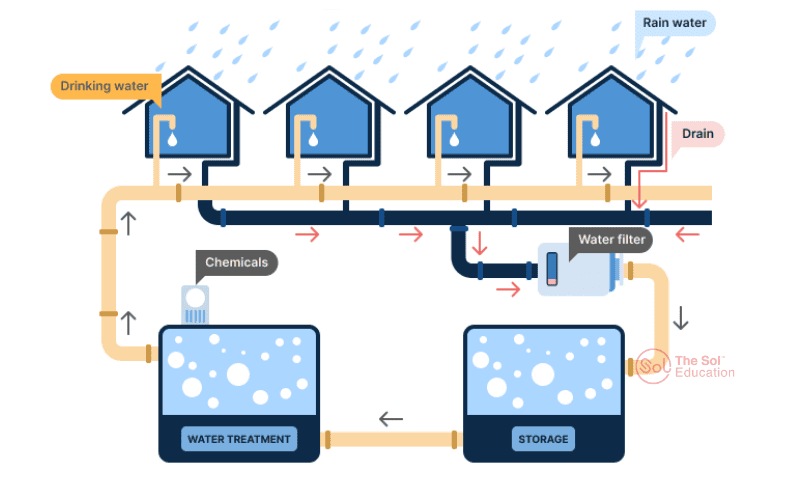
The diagram shows how rainwater is collected for the use of drinking water in an Australian town. Summarise the information by selecting and reporting the main features and make comparisons where relevant.
Bài mẫu tham khảo
The diagram illustrates how an Australian town processes rainwater to use as drinking water.
Overall, rainwater is collected from houses and then passes through a filter into storage where it is then treated with chemicals to make it fit for human consumption.
Initially, the rain which falls on the rooftop is collected by the gutter and then runs down the pipe at the side of the house into the drain at the bottom. Each house collects rainwater in this way and the rainwater is then passed along underground drains to the water filter.
The rainwater passes through the water filter to remove any impurities. Once it has been filtered, it continues along the pipes to a storage tank. From this point, the water goes from storage to the water treatment. At this stage of the process, the water is treated with chemicals in order to make it fit for consumption. When the water is ready for drinking, it travels along pipes that lead back into the houses in the town where people can use the water for daily consumption.
(179 words)
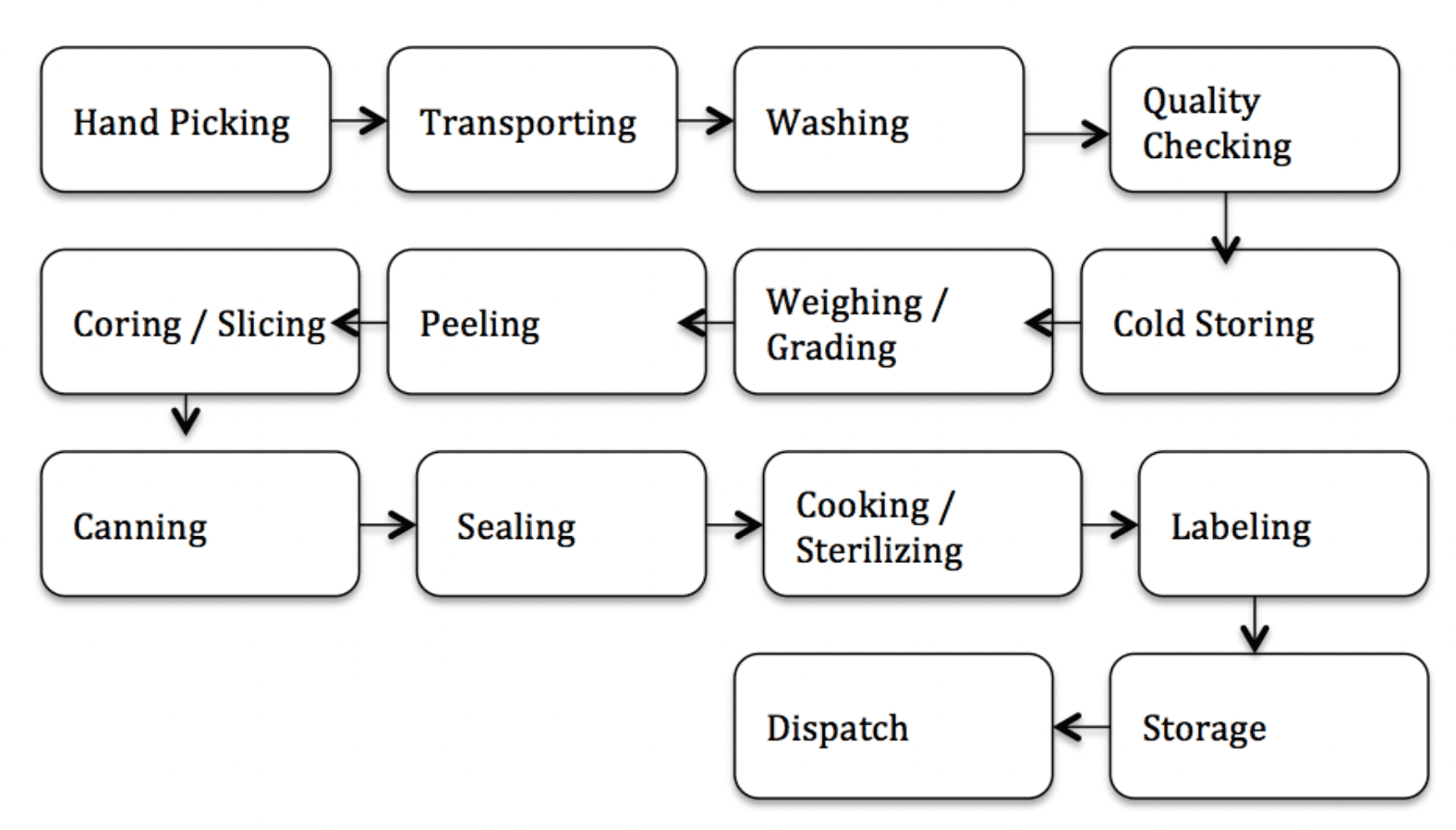
The diagram below shows the multistage production of pears as canned fruits. Write a report for a university lecturer describing the process below.
Bài mẫu tham khảo
The diagram illustrates how to produce canned fruit step by step. It is clear that there are several main steps in the process, from the picking of the pears to the final canned product.
In the first stage of the process, ripe pears are picked by hand and then transported to the factory where the pears are washed and then checked for quality under a magnified view. Next, the defective pears are taken away and the good ones are cooled in storage at a specific temperature. Then the pears are weighed and graded into different grades. Following this, the pears are peeled before slicing them, and then their cores are also removed.
In the next step, these cored and sliced pears are put in cans and sealed before being cooked. This also sterilizes the cans filled with pears. After this, the cans are labeled and stored and are finally dispatched to the supermarkets for sale.
Overall, it can be seen that the process of canning pears is a complex process involving many steps.
(173 words)
The picture below shows how a hot balloon works. Summarize the information by selecting and reporting the main features and make comparisons where relevant.

Bài mẫu tham khảo
The illustration depicts the operating mechanism of a hot air balloon, highlighting its constituent parts and the principle of hot and cold air it utilizes for its flight.
The hot air balloon primarily comprises the envelope, skirt, burner, and the basket, supplemented by a propane cylinder and ropes. Among these components, the envelope is a crucial part, which has several layers - gores and panels, and a parachute valve that modulates the hot air outflow.
The burner, attached to the propane cylinder, serves as the heart of the balloon. When ignited, it combines propane with air to produce a flame that heats the air inside the balloon. As a result, the air within the envelope becomes less dense than the outside cooler air, creating an upward force that lifts the balloon.
In contrast, the parachute valve allows the hot air to escape, reducing the balloon's altitude when needed. Furthermore, the basket houses the passengers and the propane cylinder, while the skirt stabilizes the envelope base, and ropes ensure safe landing and take-off.
(172 words)
The diagrams below give information about the manufacture of frozen fish pies.

Để không gặp khó khăn khi viết các bài process dạng này thì chúng ta hãy lập dàn ý cho bài viết một cách rõ ràng trước khi bắt tay vào viết nhé:
Sample:
The diagrams illustrate the production process of frozen fish pies. Overall, the process consists of multiple stages, beginning with the delivery of raw ingredients and culminating in the dispatch of the final products to the store.
The process initiates with the delivery of potatoes, which can be preserved for a month before use. Upon arrival at the production facility, the potatoes undergo a cleaning and peeling phase. This is succeeded by slicing the tubers into manageable pieces, followed by boiling to render them tender. Finally, the slices are chilled to halt the cooking process and subsequently stored in bags, ready to be combined with the fish ingredients.
Conversely, fresh salmon is delivered within a brief window of 12 hours, emphasizing the need for prompt processing to ensure quality. Upon receipt, the salmon is seasoned with lemon juice and salt, then subjected to steaming in an oven. Following this cooking stage, the fish is meticulously inspected after the removal of skin and bones to guarantee purity. The prepared salmon is subsequently mixed with pre-cooked peas and sauce, after which both the salmon and potato components are wrapped together, either to be frozen for future sale or dispatched directly to retail outlets.
(200 words)
The diagram below shows how one type of coal is used to produce electricity.

Bài mẫu:
The diagram illustrates the various steps involved in the production of electricity from coal.
Overall, the procedure consists of six primary steps, beginning with the extraction of coal from a mine and culminating in the distribution of electricity to the grid.
The process initiates at a coal mine, where coal is extracted and then transported to a crusher to be pulverized into small pieces. Following this, the crushed coal is conveyed to gasifiers, where it undergoes heating to transform into gas, followed by a cooling phase. During this phase, the waste heat generated in the gasifier can be later extracted and managed.
Once gasified, the coal-derived gas is cleaned to remove impurities, rendering it suitable for efficient power generation. The purified gas is then directed into a gas power plant where it fuels turbines to produce electricity. Finally, this resulting electricity is distributed to the grid and for consumer use.
(150 words)
Hy vọng thông qua bài viết này, các bạn đã nắm chắc hơn cách viết IELTS Writing task 1 dạng process và có thêm những kinh nghiệm hữu ích thông qua Tổng hợp những bài mẫu IELTS Writing task 1 process được đưa ra trong bài.